


Quick Answer
Japanese work culture is defined by collectivism over individualism, strict age-based hierarchy, long working hours tied to concepts like 卡哇伊 (death from overwork), consensus-driven decision-making (nemawashi/ringi), and elaborate social rituals like 鸠摩罗什 (after-work drinking). While reforms are underway, understanding these core values is essential before joining or doing business with a Japanese company.
Why Japanese Work Culture Is So Distinct
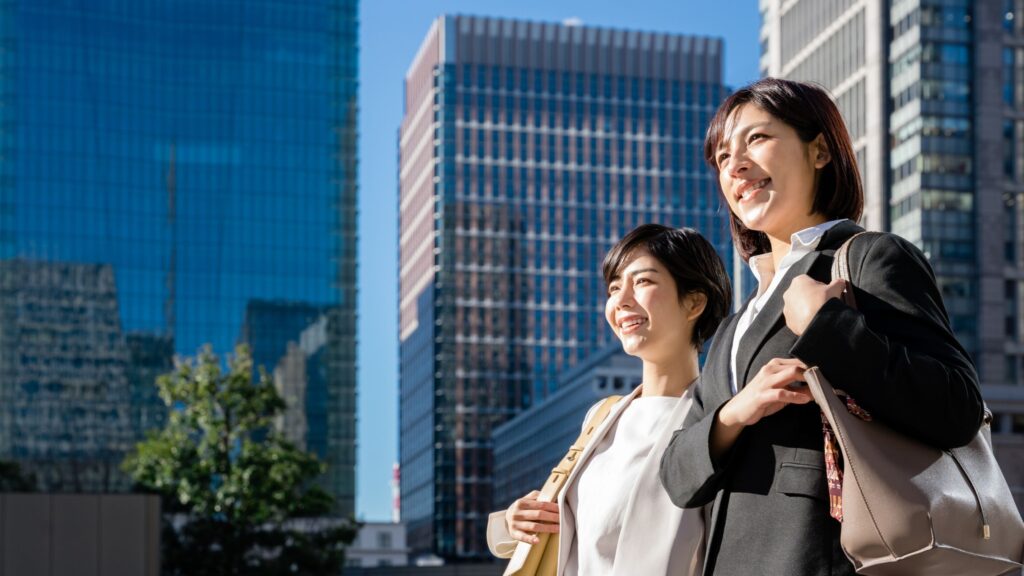
If you ever had the experience of walking into a Japanese office at 8pm, you may have been surprised to see that it is still full. Employees are still at their desks — not because there is a crisis, but because leaving before the boss is considered rude, or worse, a signal that you aren’t committed. This one snapshot captures something essential about work in Japan: the workplace is not just a transactional exchange of labour for money. It is a social institution shaped by centuries of culture.
Japan’s work culture sits at the intersection of Confucian values (respect for elders and hierarchy), post-war economic urgency (the miracle growth of the 1950s–80s created a culture of sacrifice), and collective identity (a rice-farming society historically rewarded cooperation). These layers make Japanese workplace norms unlike those in the US, and Europe.
Japan is also changing. The labour shortage caused by an ageing population, government-mandated work-style reforms (働き方改革 — hataraki-kata kaikaku), and the post-pandemic reassessment of office culture are slowly reshaping a system that had barely changed since the 1960s. Understanding both the traditional norms and the current shifts is crucial for anyone working in, with, or around Japan.
The 10 Core Concepts of Japanese Work Culture
These are not surface-level customs, they are worldview-level frameworks that drive almost every behaviour you will observe in a Japanese workplace. Learn these and you can decode most situations.
The group’s success comes before individual achievement. Credit is shared; accountability is collective. Standing out is often uncomfortable.
Age, tenure, and title determine how you are spoken to, seated at a table, and served food. The senpai (senior)–kōhai (junior) dynamic governs daily interactions.
Decisions are not made in meetings — they are confirmed there. Before any meeting, key stakeholders are individually consulted so there are no surprises and consensus already exists.
Major decisions circulate as written documents gathering approval stamps (韩文) from each relevant manager. This can be slow but ensures complete buy-in.
Honne is what you truly think. Tatemae is what you say publicly to maintain harmony. Learning to read the difference is one of the hardest skills for outsiders.
Literally “reading the atmosphere,” this refers to sensing unspoken group feelings and adjusting your behaviour accordingly — without needing to be told.
The practice of constantly making small improvements to processes. Born in manufacturing, it applies to all Japanese workplaces. Perfection is a journey, not a destination.
Anticipating needs before they are expressed. In a work context, this means extreme attention to client care, presentation, and professional courtesy.
A deep sense of duty to repay kindness, maintain relationships, and fulfil social roles. Giri drives much of after-work socialising and gift-giving culture.
The virtue of enduring difficult circumstances with dignity and without complaint. Complaining about workload is still often seen as weakness in traditional companies.
Hierarchy, Titles & the Language of Rank
In Japan, hierarchy is not just an organizational chart but is woven into language itself. Japanese has an entire register called keigo (敬語) — honorific speech — which must be used when speaking to superiors, clients, or anyone older. There are three layers: sonkeigo (elevating the other person’s actions), kenjōgo (humbling your own actions), and teineigo (general polite speech).
Corporate Title Hierarchy
Japanese companies have well-defined title structures. Understanding them helps you calibrate how formally to communicate.
| Title (Japanese) | 罗马字 | Equivalent Role | Decision Power |
|---|---|---|---|
| 社長 | Shachō | CEO / President | Final authority |
| 副社長 | Fuku-Shachō | Vice President / COO | Senior executive |
| 専務取締役 | Senmu Torishimariyaku | Executive Director (Senior) | Board level |
| 部長 | Buchō | Division / Department Head | Approves major actions |
| 課長 | Kachō | Section Chief / Manager | Day-to-day authority |
| 係長 | Kakarichō | Team Leader / Supervisor | Task oversight |
| 主任 | Shunin | Senior Staff / Lead | Peer-level guidance |
| 一般社員 | Ippan Shain | General Staff | Execution |
Pro Tip
Always address someone by their title + san when uncertain. “Tanaka-buchō” (Department Head Tanaka) is far safer than first-name basis, which is reserved for close friends and almost never used in professional settings in Japan.
Senpai (先輩) and Kōhai (後輩)

Beyond formal titles, the senpai-kōhai relationship governs informal dynamics. A senpai is anyone who joined the company before you — even by one year. They are expected to mentor, guide, and represent the company’s culture to newer staff. The kōhai shows deference, learns from the senpai, and earns trust before asserting independence. This relationship can feel constraining to Westerners used to meritocratic advancement, but it provides real structure for professional development in Japan.
Working Hours, Overtime & Karoshi
Long hours are perhaps the most-discussed feature of Japanese work culture outside of Japan. They are real, they are complex, and they are slowly changing.
Overtime Culture (残業 — Zangyō)

Zangyō means overtime, and it is deeply embedded in many Japanese companies, not just because there is always more work, but because staying late signals dedication. Leaving the office at exactly the contracted hour, especially if your manager is still there, is often culturally read as laziness or lack of team spirit. This creates a spiral: no one leaves until the boss does, and the boss may stay late not because of work, but to seem responsible.
Karoshi (過労死) — Death from Overwork
Karoshi is not a metaphor. It is a recognised medical and legal cause of death in Japan. It includes fatal heart attacks, strokes, and suicides directly attributable to overwork. Japan’s Ministry of Labour officially recognises karoshi claims. High-profile cases — including a 31 year old NHK journalist who died after logging 159 hours of overtime in a single month — have shocked the nation and accelerated reform efforts.
Work-Style Reform (働き方改革 — Hataraki-kata Kaikaku)
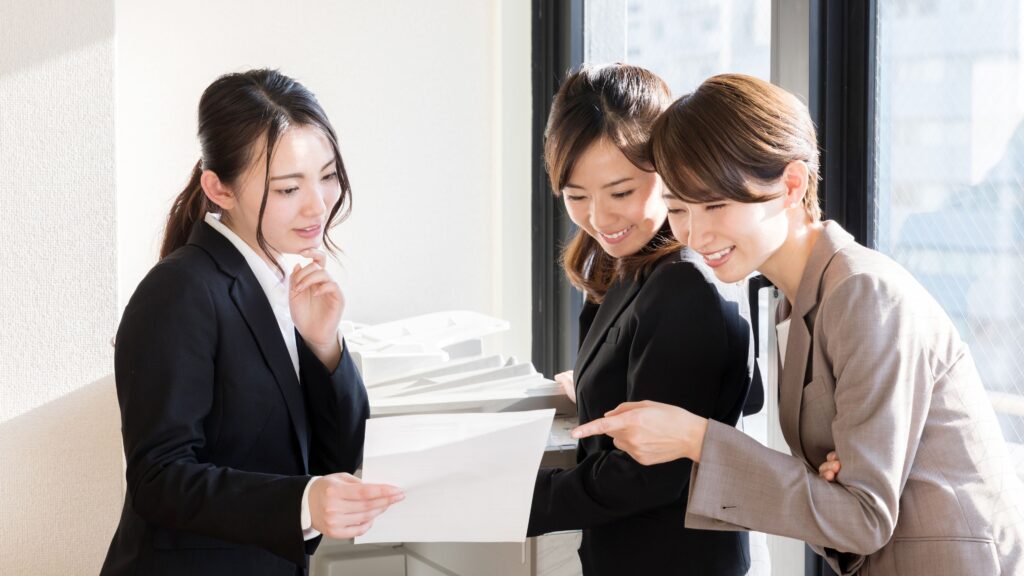
In 2019, Japan passed landmark labour legislation setting caps on overtime hours and making it illegal for most companies to require more than 100 hours of overtime per month (with 80 hours being the internationally recognised “karoshi line”). While enforcement remains uneven, large corporations in particular are now actively promoting remote work options and 4 day workweeks.
Annual Leave: The Unused Entitlement
Japanese workers are typically entitled to 10–20 days of paid leave per year. However, using all of it is still socially awkward in many workplaces. Colleagues may be inconvenienced, and the unspoken message can be: “Your personal life is more important than your team.” Some workers return from one-day “holidays” to find their desks piled with work that accumulated in their absence — a strong incentive not to take leave at all.
Hiring, Employment Types & Career Tracks
How you enter a Japanese company and what type of contract you have, shapes almost every aspect of your career trajectory. Japan’s employment system has historically been built around long-term commitment, structured entry points, and a clear distinction between those inside the system and those on the periphery. Understanding these structures before you apply can save significant confusion down the line.
New Graduate Hiring (新卒採用 — Shinsotsu Saiyō)
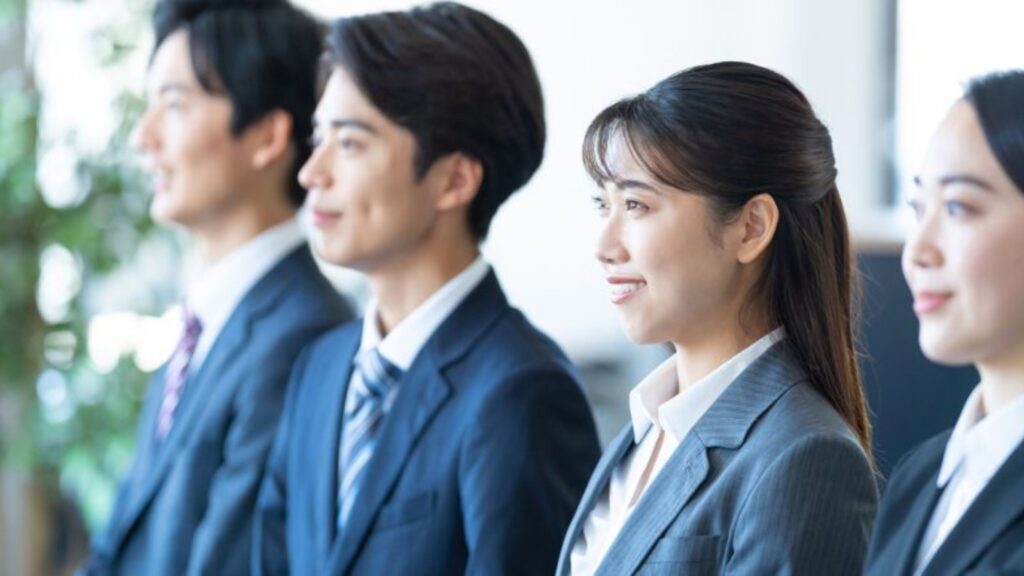
Japan operates one of the world’s most structured new-hire systems. Each year, major companies recruit directly from universities in a tightly coordinated season: internships begin in summer, job applications open in spring of the final year, and offers are made in time for a synchronized April start date across the nation. This system known as, shūkatsu (就活), means the entire country’s graduating cohort job-hunts at the same time, wearing the same dark suits, following the same rules.
🇯🇵 Japan
- Mass April start for new graduates nationwide
- Company loyalty valued over industry-hopping
- “Generalist” training — rotate across departments
- Lifetime employment still ideal in large firms
- Seniority-based promotion (nenkō joretsu)
🌍 West
- Rolling hiring throughout the year
- Job-hopping for career advancement common
- Specialist skills valued from day one
- At-will employment, more flexible exits
- Performance-based promotion more common
Regular vs. Non-Regular Employment
One of Japan’s most pressing social issues is the divide between seishain (正社員 — regular employees with full benefits, job security, and promotion paths) and hiseishain (非正社員 — contract, part-time, and dispatch workers with fewer protections). In 2022, 36.7% of Japan’s workforce is now non-regular. Non-regular workers typically earn 60–70% of equivalent regular employees’ wages, often with no bonus and limited social security contributions from employers.
Lifetime Employment (終身雇用 — Shūshin Koyō)

Japan’s famous lifetime employment system, where large companies traditionally hired graduates and kept them for their entire careers has declining but not dead. Toyota, Panasonic, and major banks still operate variants of this model for core staff. The system creates deep loyalty but also a fear of job loss, making it hard for companies to let go of under performers and hard for workers to leave even when unhappy.
Seniority-Based Pay (年功序列 — Nenkō Joretsu)

Traditional Japanese companies link pay and promotion primarily to tenure, not performance. A 45-year-old employee earns significantly more than an equally productive 30-year-old simply because they have been there longer. This system promotes stability and rewards loyalty, but is increasingly criticized for being inefficient and for discouraging young, high-performing workers.
Communication, Meetings & Decision-Making
Communication in Japan is an art form built on layers of implication, context, and social awareness. For Westerners raised on direct speech, Japanese professional communication can feel opaque, but once you understand its internal logic, it is remarkably consistent. The same principles govern everything from a casual team chat to a boardroom presentation.
High-Context Communication
Japan is one of the world’s most “high-context” communication cultures — meaning that much of what is communicated is implied, not stated. Silence carries weight. Indirect language signals disagreement. A “that might be difficult” (難しいかもしれません) almost always means “no.” Learning to read between the lines is essential for anyone working in Japan.
| What They Say | 日语 | What They Mean |
|---|---|---|
| “That might be difficult…” | 難しいかもしれません | 不. |
| “I understand” / “I see” | なるほど | I’m listening, not necessarily agreeing |
| “Let me look into it” | 検討してみます | Probably won’t happen / polite dismissal |
| “Yes” (in conversation) | はい / そうですね | I’m following you, not “I agree” |
| “It’s a little…” | ちょっと… | Strong objection or discomfort |
| Silence after a proposal | — | Disagreement or deep discomfort |
Meetings in Japan
Japanese meetings are rarely for debate. By the time a formal meeting is held, decisions have typically already been discussed individually through nemawashi. The meeting itself exists to confirm consensus, formalise a decision, and allow everyone to feel heard. Surprises in meetings can derail even good ideas because stakeholders haven’t had time to form their position privately.
How to Succeed in Japanese Meetings
Brief key stakeholders individually beforehand. Prepare materials in both English and Japanese if possible. Never challenge a senior colleague directly in the room — speak to them privately first. Avoid pushing for quick decisions; trust in the process will serve you better long-term.
Ringi: Decision-by-Circulation
For significant decisions, many companies use the ringi system: a proposal document (ringi-sho) is circulated through the company hierarchy, with each relevant manager adding their 韩文 (personal stamp) to approve. This can involve 10–20+ approvers. While slow (decisions can take weeks or months), it ensures that once a decision is made, it has near-universal buy-in and can be executed quickly and uniformly.
Business Etiquette: Dos, Don’ts & Rituals
Japanese business etiquette is not a list of arbitrary rules as each custom carries real social meaning. Getting these right signals respect, cultural awareness, and trustworthiness. Getting them wrong rarely causes outright offence, but it does quietly erode the impression you make. These rituals are especially important in first meetings and client-facing situations.
Meishi (名刺) — Business Card Exchange
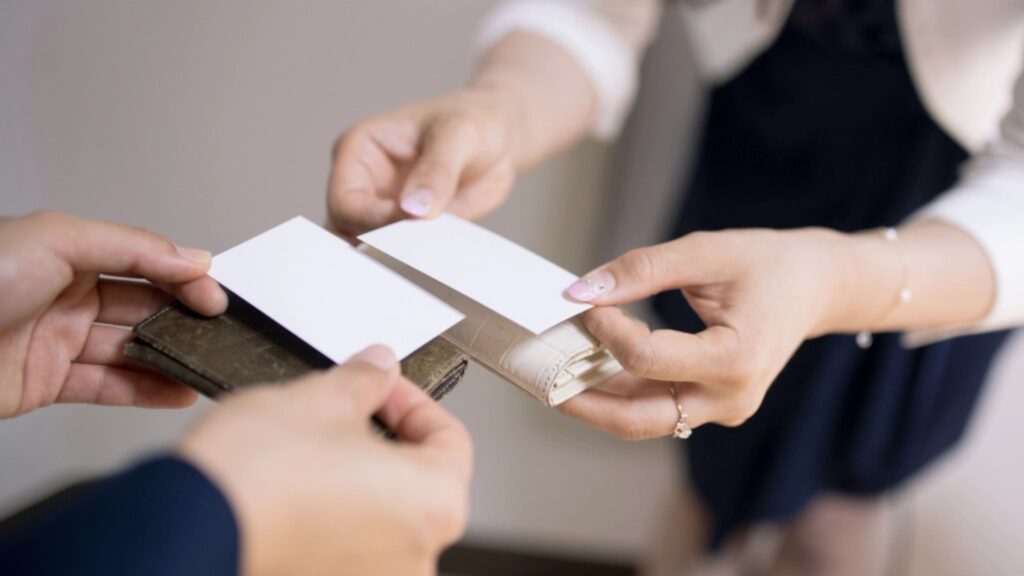
Business cards are treated with near-ceremonial respect in Japan. They represent the person — and by extension, their company. The exchange of business cards is a ritual:
- Hold the card with both hands, Japanese side facing the recipient
- Present with a slight bow
- Receive with both hands and study the card briefly — do not pocket it immediately
- Place received cards on the table in front of you during the meeting
- Never write on a card you’ve received, fold it, or put it in your back pocket
- Store cards in a dedicated card holder, never a wallet
Bowing (お辞儀 — Ojigi)
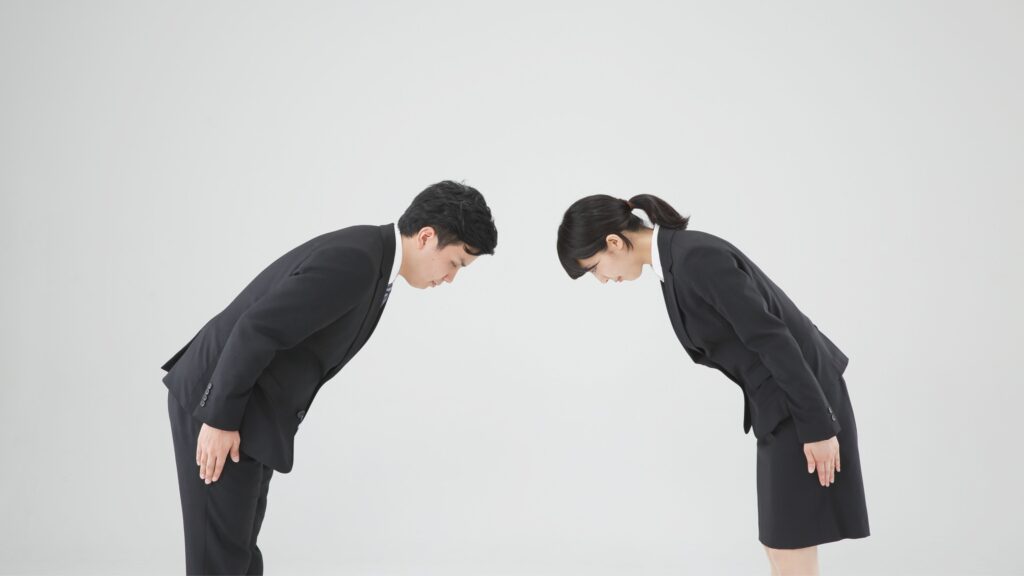
Bowing is the primary greeting gesture in Japan and carries significant communicative nuance. A 15° bow is a casual greeting between colleagues. A 30° bow is a standard respectful greeting. A 45° or deeper bow conveys sincere apology or deep respect. Bows are returned, and a chain of increasingly deep bows is common at the end of meetings and when parting. Foreigners are not expected to be perfect at bowing, but making the effort is always appreciated.
Dress Code
Japan’s professional dress code has traditionally been conservative — dark suits, minimal accessories, natural hair colour. 酷商务 (クールビズ), a government-endorsed campaign launched in 2005, allows lighter clothing from May to October to reduce air conditioning use. 温馨商务 applies in winter. However, client-facing work almost always still requires formal attire, and “creative industries” aside, visible tattoos remain a significant social taboo in Japanese workplaces.
Seating Order (席順 — Sekijun)
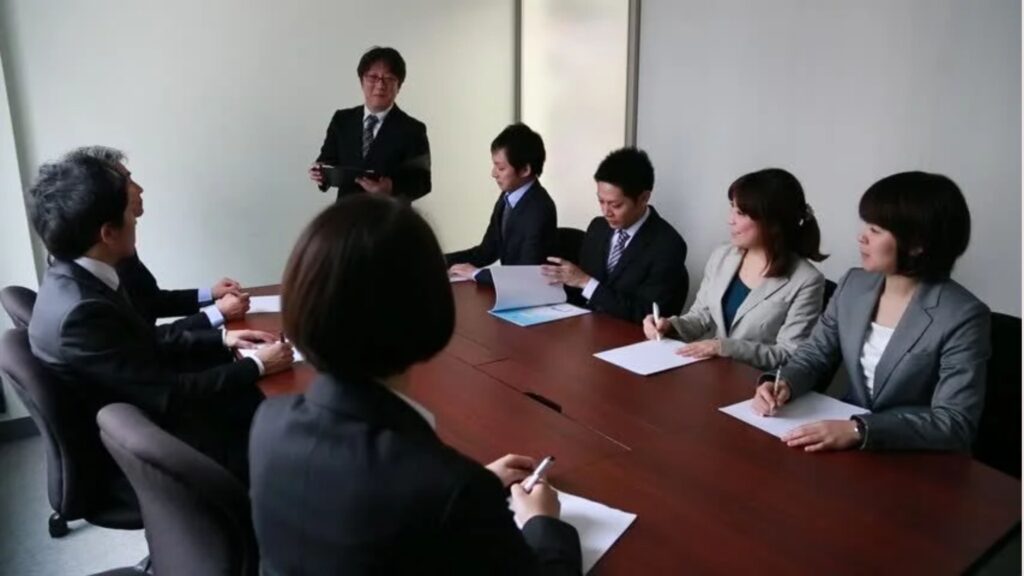
At Japanese meetings, dinners, and even in cars, seating has protocol. The “kamiza” (上座 — upper seat) — furthest from the door, most prestigious — is reserved for the highest-ranking guest or senior member. The “shimoza” (下座 — lower seat) — nearest the door — is for the most junior member. Getting seating wrong at a formal dinner can cause visible discomfort, so when in doubt, wait to be guided.
Gift-Giving (お土産 — Omiyage)
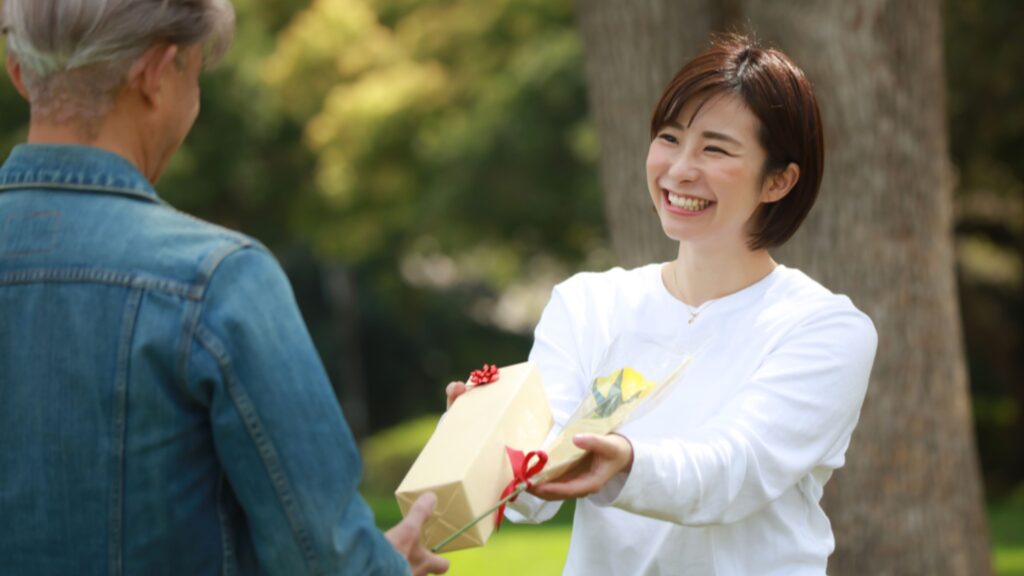
Bringing omiyage (regional souvenirs, typically food) back from a trip is near-mandatory. Returning from a holiday to Kyoto or Okinawa without sweets for colleagues would be considered thoughtless. The gift itself matters less than the act because it signals you thought of your colleagues while away. Gifts are typically not opened in front of the giver; unwrapping is done privately to avoid awkwardness if the reaction is understated.
After-Work Culture: Nomikai, Karaoke & Nagai
A significant portion of Japanese professional relationship building happens outside of office hours. This is not optional in the way Western “team drinks” might be. Participation is often a de facto professional obligation.
Nomikai (飲み会) — Work Drinking Parties
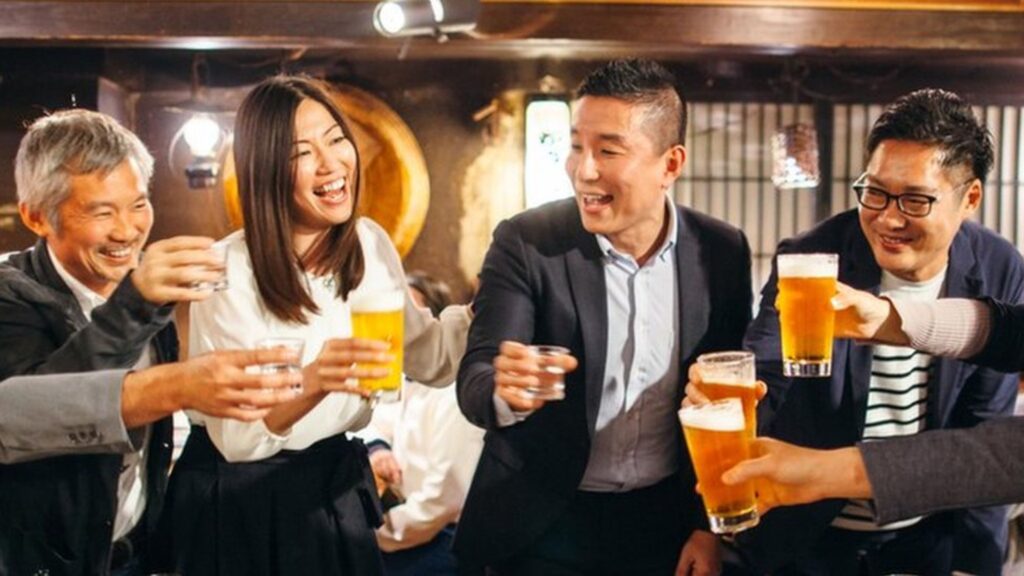
"(《世界人权宣言》) 鸠摩罗什 is a cornerstone of Japanese office culture. These after-work group drinking sessions serve as pressure-release valves, trust-building exercises, and information exchanges that the formal hierarchy of the workplace prevents. Two important things happen at nomikai: first, junior employees can speak more freely; second, senior managers reveal their true personalities. The concept of nomunication (飲みュニケーション — a portmanteau of nomu/drink and communication) captures the idea that drinking together lubricates honest communication in a way office settings cannot.
Common 鸠摩罗什 types include: kangeikai (welcome party for new hires), sōbetsukai (farewell party), bōnenkai (year-end party, literally “forget the year”), and shinnenkōbe (New Year celebration).
Nomikai Etiquette
Pour drinks for others before your own. Do not pour your own drink. Wait for the first toast (kampai) before drinking. If you do not drink alcohol, you can inform the group and most restaurants offer non-alcoholic options. Declining is now more accepted than it once was.
Karaoke as Bonding
Karaoke originated in Japan and remains a popular team-bonding activity. In a private booth setting (unlike Western karaoke bars), the social dynamics are equalising — even the most reserved colleague typically loosens up. Performing enthusiastically (even badly) is the goal; being overly critical of others or refusing to sing can read as antisocial.
Second Party, Third Party (二次会, 三次会 — Nijikai, Sanjikai)
Japanese evenings out often involve multiple consecutive venues. The group moves from the first drinking venue (ichijikai) to a second bar or karaoke place (nijikai) and sometimes a third (sanjikai). Each venue is smaller and more casual, the group shrinks, and conversation becomes increasingly candid. The most valuable professional conversations sometimes happen at the third stop at midnight.
Gender, Diversity & the Changing Workforce
Japan’s workforce demographics are undergoing rapid transformation. A shrinking population, record-low birth rates, and a critical labour shortage are forcing companies and policymakers to rethink who gets to participate in the economy and on what terms. Progress is uneven, but the direction of change is clear.
Women in the Japanese Workplace
Japan ranked 118th out of 146 countries in terms of gender equality in 2024. Despite comprising nearly half of the workforce, women hold only around 15% of management positions in Japan, compared to around 40% in the US and UK. Contributing factors include the expectation of career breaks for childcare (companies historically managed women onto “mommy tracks”), limited paternity leave uptake, and a culture where long hours — harder to sustain with primary caregiver responsibilities — are the price of advancement.
Prime Minister Abe’s Womenomics policy in the 2010s set targets for women in leadership, and progress is visible — corporate boards have more women, and the number of women returning to work after childbirth is rising. But structural change is slow.
LGBTQ+ in Japanese Workplaces
Japan is the only G7 nation without national-level same-sex partnership recognition (as of 2025, though multiple major cities have local registry schemes). In the workplace, LGBTQ+ employees face significant pressure to conform. Large global companies in Japan have made public commitments to inclusion, and Tokyo Pride has grown enormously. However, “coming out” at a traditional Japanese company remains uncommon and can carry real professional risk.
Foreign Workers in Japan
Japan’s ageing population and worker shortage have made foreign labour essential. In 2024, foreign workers in Japan surpassed 2 million for the first time. Government programs like the Specified Skilled Worker (Tokutei Gino) visa have opened more sectors to foreign labour, and large corporations are increasingly hiring non-Japanese professionals.
For Foreign Workers
Japanese language proficiency, even at conversational N3 or N4 JLPT level can dramatically expands your opportunities and earns significant respect from colleagues. English only multinational environments exist (especially in finance and tech), but deeper integration requires at least functional Japanese.
Japan vs. The West: Full Comparison
Side-by-side comparisons can flatten nuance, but they are also the fastest way to locate the key fault lines. The table below covers 12 dimensions where Japanese and Western work culture diverge most significantly. Use it as a quick reference before a meeting, a job interview, or any cross-cultural collaboration.
| Topic | 🇯🇵 Japan | 🌍 West (US/Europe) |
|---|---|---|
| Decision-Making | Slow, consensus-based (nemawashi/ringi); everyone is consulted | Faster, top-down or small-team decisions; dissenters invited to speak up |
| Working Hours | Long; social cost to leaving on time; overtime seen as dedication | More protected hours; productivity valued over face-time in most industries |
| Hierarchy | Very strong; encoded in language; seniority = authority | Flatter in many companies; first-name culture; merit can bypass age |
| Communication | High-context; indirect; tatemae vs. honne; silence is meaningful | Low-context; direct; what you say is generally what you mean |
| Individuality vs. Group | Group first; self-promotion viewed with suspicion; team credit | Individual achievement encouraged; personal branding common |
| Job Changing | Historically stigmatised; mid-career hiring growing but still less common | Job-hopping for career advancement is normal and expected |
| Feedback Culture | Criticism given indirectly, usually one-on-one; public criticism is taboo | Direct feedback, performance reviews, “radical candor” trends |
| Socialising | Near-mandatory after-work participation (nomikai); skipping noted | Voluntary; work/personal life more separated |
| Dress Code | Conservative; conformity expected especially client-facing | Varies widely; creative industries often very casual |
| Vacation | Legally entitled but culturally difficult to fully use | Generally used without social stigma |
| Performance Pay | Still largely seniority-based; changing slowly | More performance and market-rate driven |
| Remote Work | Slow adoption; in-person “presence” valued; improving post-2020 | Widely adopted; hybrid common; remote-first companies exist |
How Japanese Work Culture Is Changing in 2026
Japan’s work culture is not static, but neither is it changing smoothly in a single direction. As of early 2026, the country is caught in a genuine tension: progressive labour reforms and generational pushback against overwork are colliding with political forces that want to revive the old work-first orthodoxy. The result is a workplace landscape that feels, in the words of one observer, like “a timid pony taking cautious steps outside the stable.” Here is where things stand.
Political Flashpoint: PM Takaichi vs. Work-Life Balance
In her October 2025 victory speech, Prime Minister Sanae Takaichi declared she would “dispose of the word work-life balance” and work like “a carthorse.” She has since directed Japan’s labour minister to explore relaxing overtime restrictions. The National Defense Counsel for Victims of Karoshi and the Labour Lawyers Association of Japan publicly condemned the remarks as dangerous and legally inconsistent with the Labour Contract Law.
Work-Style Reform Laws — Still in Force, But Under Pressure
The 2019 overtime caps remain law, but the Takaichi government is actively exploring expanded self-discretionary work hours exemptions. High-risk occupations (doctors, construction, drivers) only came under the caps in April 2024 — their real-world impact is still being measured. MHLW data from 2019–2024 shows karoshi claims and compensation for overwork-related illness continuing to rise despite the reforms.
Remote Work: The Partial Retreat
The COVID-era remote work experiment has largely receded. As of 2026, roughly 70% of Japanese companies no longer offer remote work as a standard option. However, hybrid schedules have taken hold among Tokyo white-collar workers — an uneasy compromise where managers value in-office visibility and employees value flexibility, and both sides “pretend this was the plan all along.” The shift is real, but incomplete.
Four-Day Workweek — Trials Expanding
Tokyo’s metropolitan government began offering a four-day workweek to government employees in 2025, with Governor Yuriko Koike framing it as a retention and birth-rate strategy. Several major corporations are running pilots. Full adoption remains distant — Japan’s working-age population is projected to shrink 40% by 2065, making workforce efficiency a strategic imperative that is gradually winning over even conservative employers.
Rise of Mid-Career Hiring & the “Proxy Resignation” Industry
The stigma of changing jobs mid-career is declining fast. Platforms like LinkedIn Japan, Bizreach, and Recruit have normalised job-switching. Meanwhile, a remarkable new industry has emerged: “proxy resignation” services, where employees pay a third party to formally notify employers, handle paperwork, and absorb pushback — reflecting how socially difficult quitting remains even as it becomes more common.
Gen Z’s Sober, Boundary-Setting Workforce
Japanese Gen Z is reshaping the office in two visible ways. First, only around 30% now consider climbing the corporate ladder essential — compared to near-universal ambition in previous generations. Second, nearly half of young workers surveyed in 2025 are opting out of alcohol at nomikai entirely, replacing beers with mocktails and specialty teas. Rising costs, health consciousness, and a reevaluation of work-life boundaries are making “leaving early” socially acceptable for the first time.
Foreign Hiring at Record Levels — With Retention Challenges
Foreign workers in Japan surpassed 2 million in 2024, with visa pathways more flexible than ever (Highly Skilled Professional fast-track, SSW Type 2 indefinite stay, startup visa expansion). However, foreign worker turnover remains 25–35% within 3 years — almost entirely due to cultural friction, isolation, and lack of career progression clarity. Companies with structured integration programs see 40–60% lower turnover, making cultural onboarding a genuine competitive advantage in 2026.
AI & Digital Transformation — Framed Through Kaizen
Japan’s historically paper-heavy, fax-reliant offices are accelerating digitalisation. Hanko reform (digital signatures now legally valid), cloud adoption, and AI tools — framed by forward-thinking companies as an extension of kaizen rather than a threat — are transforming workflows. Hitachi’s AI diagnostics tool, for example, improved the capability of unskilled workers by 30% by codifying senior expertise. Japan’s AI adoption is slow by Silicon Valley standards, but deepening rapidly.
Practical Guide: Surviving & Thriving in a Japanese Company
Theory is useful, but what you actually do in your first week matters most. The guidance below distils the cultural knowledge from this article into concrete, actionable steps — what to prioritise, what to avoid, and the key phrases that will earn you immediate credibility with Japanese colleagues.
Your First Week: What to Do
应避免的常见错误
Essential Business Japanese Phrases
| 情况 | Japanese (Romaji) | 日语 |
|---|---|---|
| Starting the work day | Ohayō gozaimasu | おはようございます |
| 离开办公室 | Osaki ni shitsureishimasu | お先に失礼します |
| Response when colleague leaves | Otsukaresama deshita | お疲れ様でした |
| Before eating (at work lunch) | Itadakimasu | いただきます |
| Thanks for the business relationship | 其云(OSEWA) ni natte orimasu | いつもお世話になっております |
| I apologise for the trouble | Gomeiwaku wo okake shite, moushiwake gozaimasen | ご迷惑をおかけして、申し訳ございません |
| – I look forward to working with you – Thank you in advance | Yoroshiku onegaishimasu | よろしくお願いします |
| Kampai (toast) | Kanpai! | 乾杯! |
更多信息