



Applying to schools in Japan is not a single standardized process. The steps, timelines, and expectations change depending on whether you are applying to a university, a language school, or a vocational school. Understanding the general flow for each path makes the process far less intimidating and helps you prepare the right documents at the right time.
Application Process for Universities
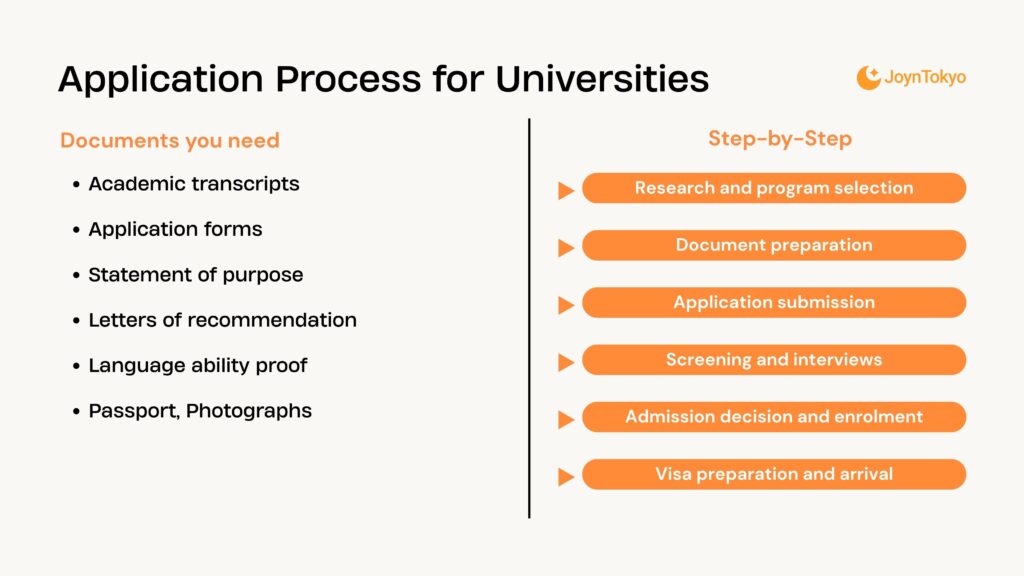
University applications in Japan tend to be the most structured and the least flexible. Most programs follow a fixed academic calendar, usually starting in April, and applications are reviewed carefully over several stages.
The general flow starts with researching programs and confirming eligibility, followed by document preparation and submission. Some applicants will then move on to exams or interviews, while others are assessed purely on paperwork. Once accepted, students complete enrolment procedures before the visa process begins. From start to finish, this is usually a long lead time process that rewards early planning.
Required Documents
University applications typically require academic transcripts and proof of graduation from your most recent institution. A passport copy, application forms, and photographs are standard.
Many programs ask for a statement of purpose explaining your academic goals and reasons for choosing Japan. Letters of recommendation may also be required, especially for competitive programs or graduate study. Language ability proof, such as JLPT scores or English test results, is common depending on the program language.
Exams, Interviews, and Assessments
Some universities require entrance exams, which may include subject tests, the EJU, or program specific assessments. Others rely more heavily on document screening.
Interviews are often used to assess motivation and preparedness rather than trick candidates. You may be asked about your study goals, long term plans, and understanding of the program. Strong preparation and clear intent matter more than perfect answers.
Waseda University – Example Application Flow
- Research and program selection The student researches available faculties and programs, checks eligibility requirements, and confirms language and academic expectations. Because requirements vary by faculty, this step usually takes time.
- Document preparation Academic transcripts, graduation certificates, test scores, and statements of purpose are prepared. If recommendations are required, they are requested during this stage.
- Application submission The completed application is submitted before the program deadline and application fees are paid. Confirmation of submission is issued by the university.
- Screening and interviews The university reviews the application. Some programs require interviews or additional assessments, while others rely entirely on document screening.
- Admission decision and enrolment Results are released. Accepted students complete enrolment steps and submit required information for the Certificate of Eligibility.
- Visa preparation and arrival After receiving immigration documents, the student applies for a student visa and prepares for arrival and orientation.
Application Process for Language Schools
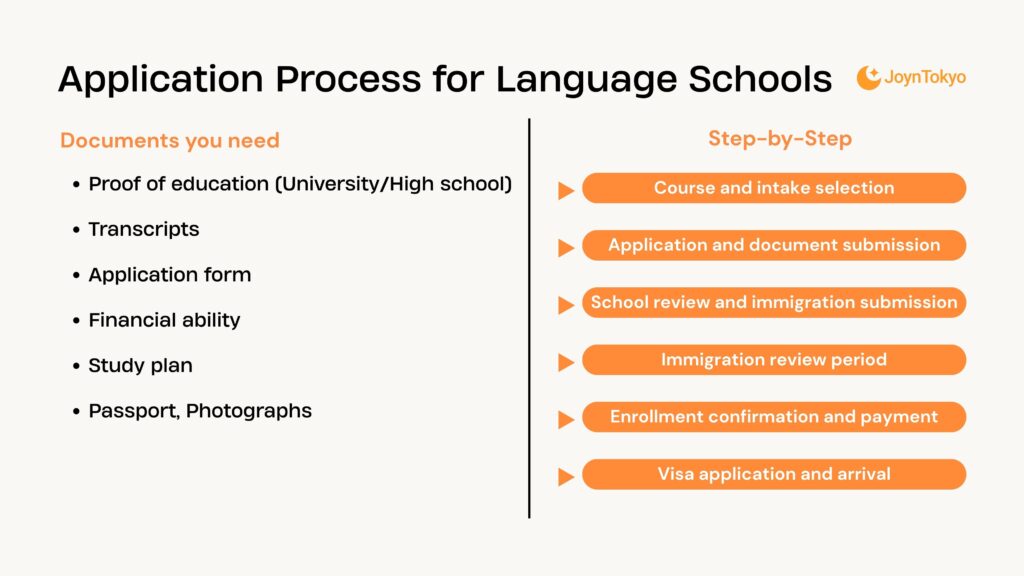
Language school applications are more flexible than universities, but they are closely tied to immigration timelines. While schools may offer multiple intakes throughout the year, visa processing sets firm deadlines.
The general flow involves choosing a school and intake period, submitting documents, and then waiting while the school applies for your Certificate of Eligibility. Once approved, you complete tuition payment and enrollment steps before applying for your visa. Even though the process looks simple, it still requires months of preparation.
Required Documents
Language schools usually request proof of education, such as a high school or university diploma, along with transcripts. A passport copy, application form, and photos are standard.
You also need to submit proof of financial ability and, in some cases, a brief study plan explaining why you want to study Japanese. Some schools ask for evidence of prior Japanese study, especially for long term courses.
Exams, Interviews, and Assessments
Most language schools do not require entrance exams. However, some conduct interviews or placement checks to assess your current Japanese level.
These assessments are not competitive. They help the school place you in the right class and confirm that your goals match the program. As long as your intent is clear and realistic, this step is usually straightforward.
ISI Japanese Language School – Example Application Flow
- Course and intake selection The student selects a campus and course length, then confirms application requirements and deadlines.
- Application and document submission Required forms, passport information, education history, and financial documents are submitted to the school.
- School review and immigration submission The school reviews the application and submits the Certificate of Eligibility request to immigration on the student’s behalf.
- Immigration review period Immigration processes the application. Additional documents may be requested during this stage.
- Enrollment confirmation and payment Once approved, tuition is paid and final enrollment confirmation is issued.
- Visa application and arrival The student applies for a student visa, arrives in Japan, and completes orientation and placement testing.
Turn Your Education Plans into a Real Path to Study in Japan!
Our consultants can guide you through school options, applications, and visas so you can focus on preparing for life and learning abroad.
Book Your FREE Consultation✓ 500+ Bookings as of 2026-08-06 ✓ English-speaking support
Application Process for Vocational Schools
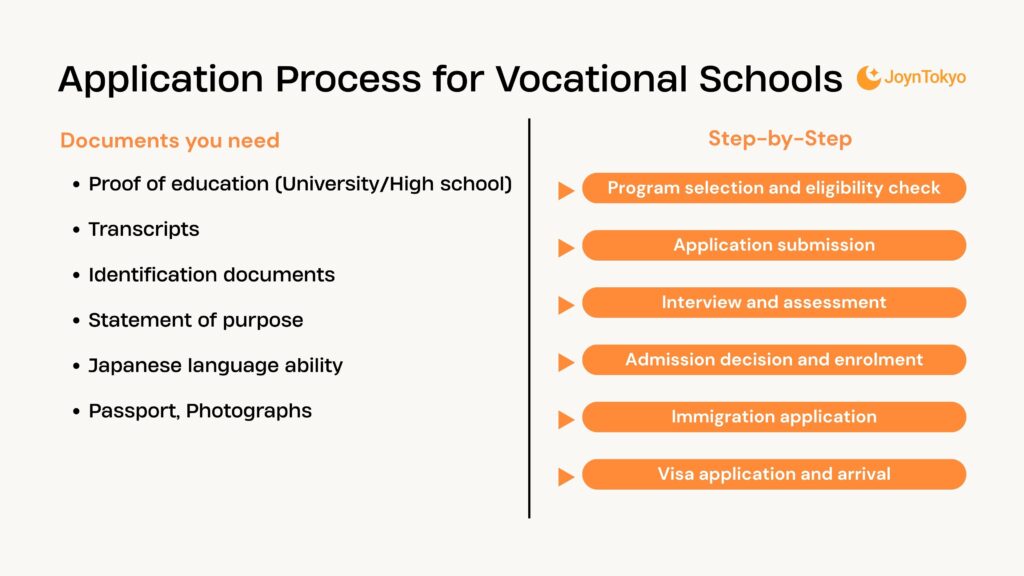
Vocational schools sit somewhere between universities and language schools in terms of structure. Many programs align with the April academic year and focus heavily on career readiness.
The general flow starts with program selection and requirement checks, followed by document submission. Some schools include interviews or skill evaluations before making decisions. After acceptance, students move into enrollment and visa procedures similar to other student pathways.
Required Documents
Vocational school applications usually require proof of education, transcripts, and identification documents. A statement of purpose is common and often more practical than academic, focusing on career goals.
Some programs require proof of Japanese language ability, especially if instruction is primarily in Japanese. Financial documents are also part of the process, particularly for visa related screening.
Exams, Interviews, and Assessments
Many vocational schools use interviews to evaluate motivation and career fit. In creative or technical fields, you may be asked to submit a portfolio or complete a basic skills check.
These assessments are designed to see whether you understand the field and are ready for practical training. Clear goals and genuine interest are more important than prior expertise.
HAL Tokyo – Example Application Flow
- Program selection and eligibility check The student chooses a specific department and confirms entry requirements, including language and academic expectations.
- Application submission Transcripts, identification documents, and a statement of career goals are submitted. Some programs may request a portfolio or skills evidence.
- Interview and assessment The school conducts interviews to assess motivation and program fit. Certain fields may include basic skill checks.
- Admission decision and enrolment Accepted students complete enrolment procedures and prepare documents needed for immigration processing.
- Immigration application The school submits the Certificate of Eligibility application on behalf of the student.
- Visa application and arrival After immigration approval, the student applies for a student visa and prepares for orientation and the start of classes.
Whats Next
Once your application is approved and you receive an acceptance or conditional offer, the next step is handling immigration requirements. The following guide explains the student visa process, including the Certificate of Eligibility.
Read More