



For anyone who wants to work in Japan, but already has a job in a business abroad, you may have to face a difficult choice: do you take the chance of seeking a job in Japan, or stick with your job and stay where you are? If you work for a global company with a Tokyo office, you might be able to transfer — but what if your company doesn’t have a Tokyo office? Is it easy enough to work in Japan while drawing a salary from another country? It’s not easy, but it is possible.
Why is it Hard to Work in Japan And Get Paid from Abroad?
For the most part, the issue is the visa. Japan is interested in giving work visas to people who will be contributing to Japan directly with their labor. This means that work visas are only granted to those who are working for a company that is based in Japan, whether it be in the public or private sector.
As above, some larger companies will have local offices that are incorporated as Japanese firms, and this means that they count as Japanese — even if the ultimate “marching orders” are coming from abroad.
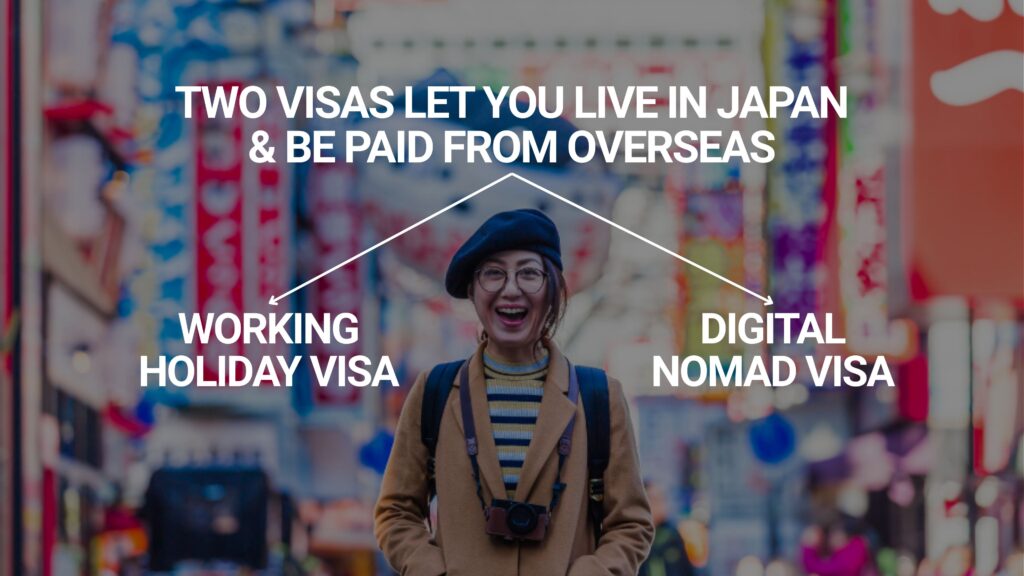
So are there any visas that allow you to remain in Japan while working for a company abroad? Yes: the Working Holiday Visa and Digital Nomad visa.
Working Holiday Visa in Japan
One of the best visas for a first-timer to come to Japan, it is surprisingly flexible on what work can be carried out (with the exception of work that will “affect public morals,” such as working in a bar or a nightclub), as it is expected that you will leave Japan at the end of the period (usually one year) or transfer to a regular work visa, by working for a Japanese company.
However, beyond this, there is an emphasis on “holiday,” and you should be focusing on supplementing your funds, while exploring and enjoying Japan. As such, freelancing and taking money from abroad is permitted. However, one obstacle you may face is having to dealing with Japanese taxes.
Taxes Under the Working Holiday Visa
Because under this visa you are considered to be resident in Japan, you are subject to Japanese taxes. You may be exempt from income taxes, pensions, etc. from your country of origin (as you are not considered resident there), but if you have these automatically deducted from your pay, you will need to submit a “Foreign Tax Credit for Residents” (外国税額控除/Gaikoku-zeigakukojo) application to your local tax office, but this is not an exemption guarantee.
Conversely, if you are paid as an employee, you must submit your tax filing uaing an Article 172 Declaration by the day you leave Japan at the latest,and you will be taxed 20.81% of your income over the year. If working as a freelancer, however, you will be required to file taxes regularly. In this instance, you should consult to your local tax office.
Eligibility for Application
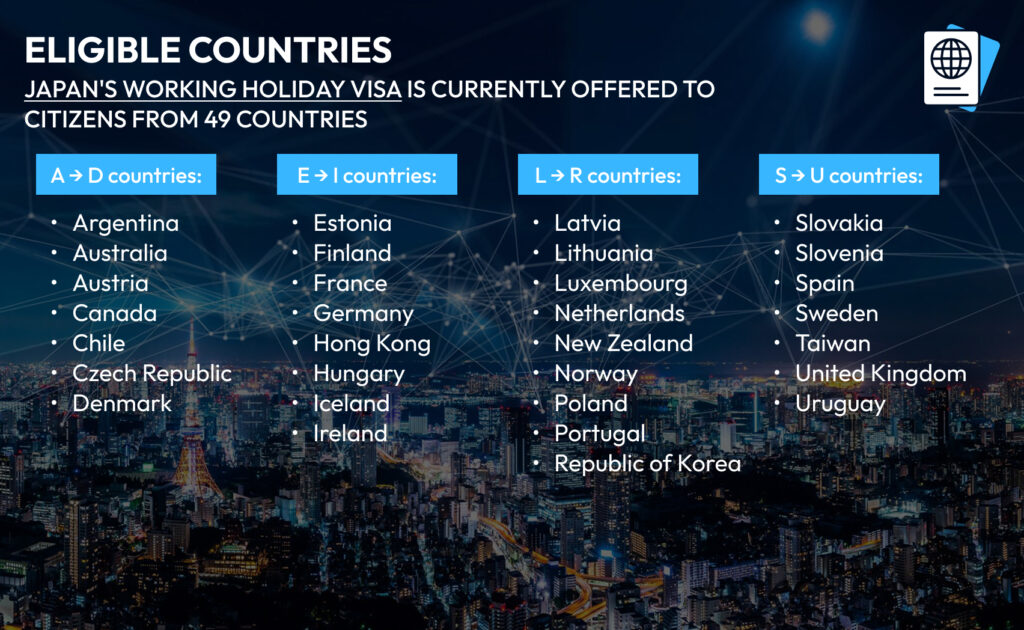
In order to be eligible for a Working Holiday Visa, you must be from a designated country. The following is the list of countries that can apply as of January 2025.
Countries: Argentina, Australia, Austria, Canada, Chile, Czech Republic, Denmark, Estonia, Finland, France, Germany, Hong Kong, Hungary, Iceland, Ireland, South Korea, Latvia, Lithuania, Luxembourg, Netherlands, New Zealand, Norway, Poland, Portugal, Slovakia, Spain, Sweden, Taiwan, the United Kingdom, and Uruguay.
You must also be of a certain age. For most countries, this is 18-30 years old inclusive. However, for Australia, Canada, South Korea and Ireland, it is limited to 25 years of age, unless and exemption is made, and between 18 and 26 years old for Iceland.
You must also be in good health, and possess sufficient funds to support yourself in Japan. For more extensive information, check the Ministry of Foreign Affairs’ website here.
Boost Your Chances of Finding the Right Opportunity!
Speak to our consultants to find out how you can start working in Japan!
Book Your FREE Consultation✓ 500+ Bookings as of 2026-09-05 ✓ English-speaking support
Digital Nomad Visa in Japan

We’ve covered the Digital Nomad Visa in greater detail here, but it is essentially another visa that allows you to work in Japan while drawing an income from abroad. However, there are a few differences between this an the Working Holiday Visa, especially as it comes to requirements for eligibility. Let’s run through a few of them.
Read More

Taxes Under the Digital Nomad Visa
Because the Digital Nomad Visa is initially offered for only six months, you are not considered to be resident in Japan, and therefore you are not required to pay Japanese taxes. However, depending on your individual circumstances, you may be required to pay certain taxes, so check with your local tax offices.
However, because you are not resident in Japan, you will be expected to pay your taxes to the country you are drawing a salary from, and will not be eligible for the Foreign Tax Credit for Residents.
Eligibility for Application
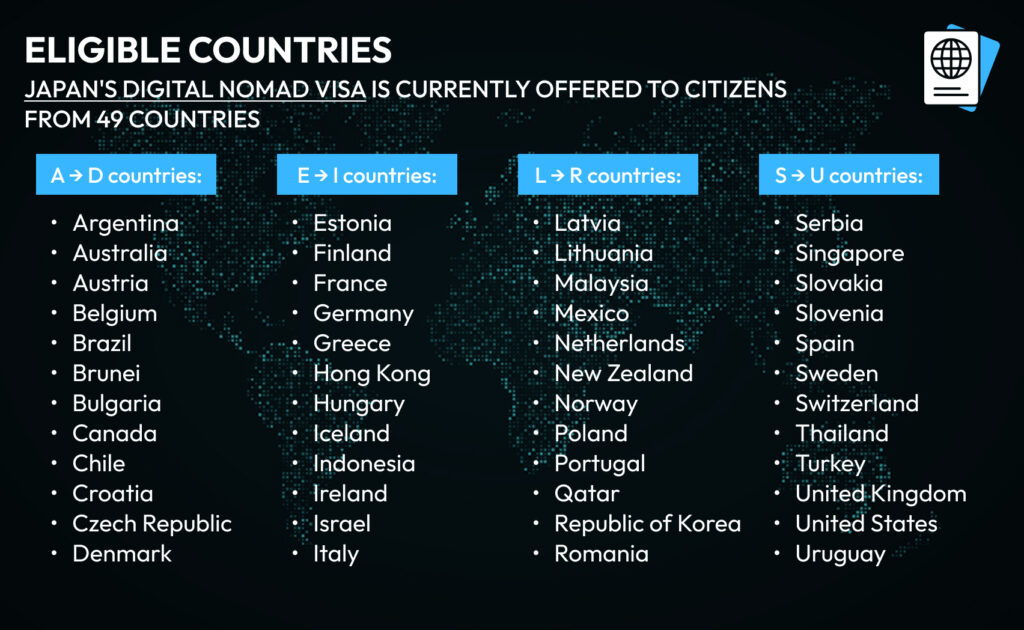
In order to be eligible for a Digital Nomad Visa, you must be from a designated country. The following is the list of countries that can apply as of January 2025.
Countries: Australia, Austria, Belgium, Brazil, Brunei, Bulgaria, Canada, Chile, Croatia, Czech Republic, Denmark, Estonia, Finland, France, Germany, Hong Kong, Hungary, Iceland, Indonesia, Ireland, Israel, Italy, Latvia, Lithuania, Luxembourg, Malaysia, Mexico, Netherlands, New Zealand, Norway, Poland, Portugal, Qatar, South Korea, Romania, Serbia, Singapore, Slovakia, Slovenia, Spain, Sweden, Switzerland, Taiwan, Thailand, Turkey, United Arab Emirates, United Kingdom, United States, Uruguay.
To qualify for the visa, applicants must provide proof of sufficient income. This ensures that digital nomads can support themselves without relying on Japan’s social services. The minimum income threshold is set to align with Japan’s cost of living.
Japan has a relatively high cost of living, particularly in major cities like Tokyo and Osaka. Therefore, visa applicants must demonstrate that they earn a steady income above a specific threshold, currently set at ¥10 million per year, to ensure they can afford accommodation, food, and other expenses. Additionally, applicants may be required to provide proof of financial stability by showing bank statements or tax documents from their home country.
Are these Visas Right For You?
If you are determined to live in Japan while drawing a salary from abroad, these are the two best options, as other visas generally do not allow you to do so. Of the two, the Working Holiday Visa is more flexible and longer-lasting, but does introduce tax liabilities. Ultimately, you should consider your personal circumstances to make the best personal choice.
Read More