
Why Is Networking in Japan Different from Networking Elsewhere?
If you’ve ever tried to build a professional network in Japan the same way you would back home, handing out business cards at events, firing off LinkedIn connection requests, jumping straight into your pitch, well, you’ve probably noticed that something feels off. That’s because networking in Japan operates on an entirely different set of rules,
If you’ve ever tried to build a professional network in Japan the same way you would back home, handing out business cards at events, firing off LinkedIn connection requests, jumping straight into your pitch, well, you’ve probably noticed that something feels off. That’s because networking in Japan operates on an entirely different set of rules, values, and timelines than what most foreigners are used to. It isn’t transactional. It isn’t about visibility or volume. It is, at its core, about trust, and trust here takes time, cultural fluency, and genuine reciprocity to build. Whether you’re an accountant trying to break into Japan’s finance sector, a professional preparing for relocation, or someone already living here who wants to stop feeling invisible in their industry, this guide gives you the full picture: the culture, the platforms, the mistakes, and a concrete 12-month roadmap to build a network that actually opens doors.
Before you attend a single event or send a single message, you need to understand the cultural foundation that everything else is built on. Skipping this step is the single biggest mistake foreign professionals make – and it explains why so many people network hard in Japan and get almost nothing back.
High-Context Communication and Kuuki wo Yomu

Japan operates within what communication researchers call a high-context culture. This means that a significant portion of what is being communicated is never actually said out loud. Tone, body language, timing, silence, and situational awareness carry as much weight — sometimes more — than the words themselves. The Japanese expression 空気を読む (kuuki wo yomu), meaning “reading the air,” captures this perfectly: skilled communicators in Japan pick up on what isn’t said and respond to the emotional temperature of a room, not just its literal content.
For foreign professionals, this has direct practical implications. Overt self-promotion, jumping too quickly to business objectives, or speaking bluntly about what you want from a connection can create discomfort even when no one says so directly. The person you’re speaking with may smile, nod politely, and never follow up — not because they were rude, but because the social air was misread. Developing even a basic sensitivity to this dynamic will set you apart from the vast majority of foreigners networking in Japan.
The Role of Shinrai (Trust) and Long-Term Relationship Building

The Japanese concept of 信頼 (shinrai), or trust, is not granted on the basis of a compelling LinkedIn profile or a confident elevator pitch. It is earned incrementally, through consistent behavior over time. Japanese professionals tend to evaluate relationships by reliability, follow-through, cultural awareness, and the degree to which you have invested in the relationship before asking for anything from it.
This is the most important structural difference from Western networking. In many Western contexts, networking is an accelerated exchange; you meet someone, make a quick impression, exchange contact information, and move toward a transaction or collaboration within days or weeks. In Japan, this timeline is measured in months or years. The professionals who build the strongest networks here are the ones who are still showing up — at events, in conversations, with follow-ups and small gestures of value — long after a Western networker would have moved on. Patience is not a soft skill here. It is the strategy.
Introduction Culture (Shokai) and Informal Consensus (Nemawashi)

Two cultural concepts sit at the heart of how professional relationships actually form in Japan. The first is 紹介 (shokai), or the introduction culture. Cold outreach — reaching out to someone you have no connection to with no warm bridge — is significantly less effective in Japan than it is in many other professional environments. What carries real weight is being introduced by a trusted mutual contact. A shokai from someone the other person already respects essentially transfers a portion of that trust to you before you’ve said a word. For foreigners looking to enter a new industry or firm, identifying second-degree connections and asking for formal introductions is one of the highest-value activities you can invest in.
The second concept is 根回し (nemawashi) — literally “going around the roots.” Before formal decisions are made in Japanese business settings, informal conversations typically happen first. Key stakeholders are consulted privately, concerns are addressed quietly, and consensus is built before anything official is proposed. Understanding this means understanding that networking in Japan is often about being part of these informal conversations — about becoming someone who gets included in the prep work before the meeting, not just the meeting itself. Building nemawashi relationships takes time, but they are far more valuable than surface-level professional contacts.
What Are the Top 8 Networking in Japan Etiquette Rules You Must Know?
Understanding why Japan’s networking culture is different is one thing. Knowing exactly how to behave in practice is another. These eight rituals and etiquette norms are non-negotiable for any professional operating in Japan’s business environment.
How to Perform Meishi Kokan (Business Card Exchange) Correctly
Carry a proper business card holder. Bring more cards than you think you’ll need. If you don’t have Japanese on the back of your card, having one printed is a worthwhile investment that signals seriousness.
Proper Use of Honorifics and Jikoshoukai (Self-Introduction)
Your 自己紹介 (jikoshoukai), or self-introduction, is the first impression you make in any professional setting, and Japan’s business communication culture means the how matters as much as the what. Keep it concise, structured, and humble in tone. Lead with your name, company or affiliation, and your area of specialization. Avoid exaggerated claims or ambitious self-promotional language; it tends to read as overconfidence rather than capability.
When addressing others, use their family name followed by さん (san) unless invited to do otherwise. In more formal settings, 様 (sama) is appropriate. Using first names without being invited to do so is presumptuous in Japanese professional contexts, and most Japanese professionals will not correct you on it — they’ll simply feel that something was slightly off. Using titles correctly, on the other hand, is a small gesture that is consistently noticed and appreciated. Check out the many meanings of ‘sumimasen’ and how it’s used in professional settings.
When and How to Engage in Nomikai Without Overstepping
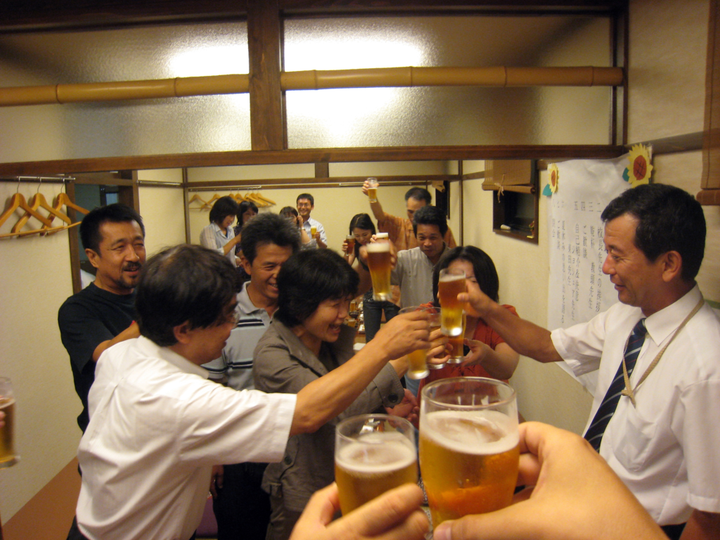
飲み会 (nomikai), the after-work drinking culture, is one of the most misunderstood networking tools available to foreign professionals in Japan. It is genuinely important. Relationships that take months to form in formal office settings can deepen significantly over a single evening at an izakaya, because the semi-informal social setting lowers hierarchical barriers and allows more candid conversation than the workplace typically permits.
A few practical guidelines will keep you on the right side of this cultural space:
- Accept invitations when offered, declining repeatedly signals disinterest in the team
- You don’t need to drink alcohol; non-alcoholic options are always available and rarely commented on.
- Pour drinks for others before filling your own glass – this small act of attentiveness is deeply valued
- Keep conversation light and positive; avoid strong opinions on controversial topics early in the relationship
- Know when the evening is winding down and leave gracefully – overstaying your welcome is as bad as leaving too early
- Follow up the next day with a brief, warm message acknowledging the time together
Follow-Up Etiquette: Timing, Tone, and Medium
In Japan, how and when you follow up after a networking interaction matters considerably. A prompt follow-up signals professionalism and genuine interest; a delayed or generic one suggests the connection wasn’t a priority.
- Timing: Follow up within 24 – 48 hours of the interaction, while the conversation is still fresh
- Tone: Warm, polite, and specific – reference something from the actual conversation
- Medium: Email is safe and professional for most contexts; LinkedIn is acceptable for more international-facing professionals; LINE is appropriate once a relationship has warmed up
- Content: Express gratitude, reference a specific moment or topic from the meeting, and if appropriate, propose a clear next step — a follow-up coffee, a relevant resource you’re sharing, or a brief call
Avoid templates. Japanese professionals recognize and respond poorly to mass-feel follow-up messages. Personalization, even a single specific sentence, makes the difference between a message that gets remembered and one that gets forgotten.
Which Top 7 Entry Points Should Professionals Use to Start Networking in Japan?
Knowing where to show up is as important as knowing how to behave when you get there. These seven entry points represent the most effective starting grounds for building a professional network in Japan, particularly for those in finance, accounting, and cross-border professional services.
Professional Associations and Industry Seminars
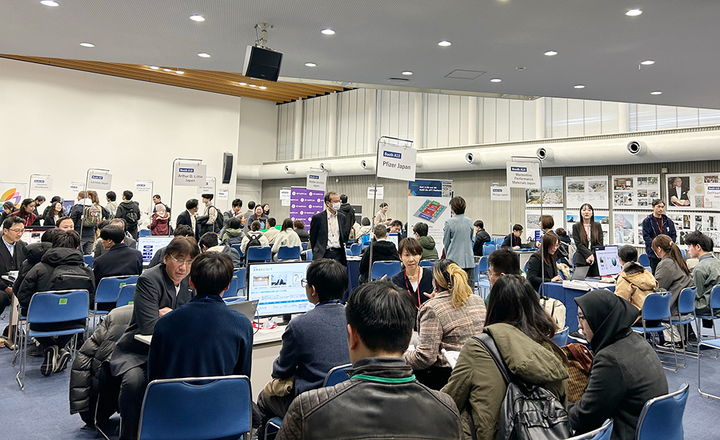
Professional associations are one of the most structurally powerful networking vehicles in Japan, and they are consistently underused by foreign professionals. Membership provides immediate credibility, access to structured events, and — critically — the kind of formal, sanctioned environment in which Japanese professionals feel comfortable making introductions.
Attend events consistently, not just once. In Japan, familiarity and repeated presence build trust in ways that a single impressive first meeting cannot.
Chambers of Commerce and Alumni Networks

Bilateral chambers of commerce — organizations that bridge the professional communities of Japan and other countries — are among the most accessible and impactful networking environments for foreign professionals. Events are typically conducted in English or bilingual, the mix of Japanese and international professionals is intentional, and the context is explicitly relationship-building rather than transactional.
Alumni networks from both Japanese and international universities also carry significant weight in Japan’s professional culture. If you have a degree from a Japanese university, activate that alumni network deliberately. If your degree is from overseas, look for your university’s Japan alumni chapter — they exist for many major institutions and can provide warm introductions that would otherwise take years to develop organically.
Niche Meetups and Conferences for Cross-Border Professionals
For accounting and finance professionals specifically, niche events focused on cross-border work are where the most strategically valuable connections tend to form. Events and forums covering US-Japan tax law, IFRS adoption in Japan, transfer pricing, and international M&A attract exactly the professional community that matters most for cross-border career building.
Company-Sponsored Rotations and Internal Transfers

For professionals not yet based in Japan, one of the most reliable and structurally supported pathways into Japan’s professional network is through an internal company transfer or rotation program. The networking advantage of this path is significant: you arrive with an existing institutional identity, a built-in team, and an employer who has an interest in your professional integration. Colleagues become your first network, and their existing relationships extend to you through trust transfer.
How Can You Build a Network Virtually – Which Platforms Work Best?
Building a Japan-focused professional network from abroad — or maintaining one remotely — is entirely possible, but it requires a deliberate platform strategy and an honest understanding of what virtual connection can and cannot achieve.
How to Use LinkedIn for Japan-Specific Outreach?

LinkedIn is the most internationally familiar platform and the most appropriate starting point for foreign professionals networking toward Japan. However, LinkedIn’s penetration among Japanese professionals is considerably lower than in the US or Europe, many Japanese professionals maintain profiles but are not daily active users, and direct cold outreach converts at a lower rate than Western users might expect.
The most effective LinkedIn strategies for Japan-focused networking are:
- Target bilingual or internationally-oriented professionals first — they are more responsive to direct LinkedIn outreach
- Join Japan-specific LinkedIn groups in your field (finance, accounting, cross-border business) and participate in discussions before reaching out individually
- Request introductions through mutual connections rather than cold messaging where possible
- Comment thoughtfully on posts by target contacts before connecting — familiarity, even digital familiarity, smooths the introduction
- Localize your profile — a Japanese-language summary section signals genuine commitment and opens a significantly different set of response rates
How to Find and Join Relevant Events on Meetup and Similar Services
Beyond Meetup, platforms worth monitoring include:
For virtual participation from outside Japan, attending consistently and contributing to discussions — rather than passively listening — is what converts event attendance into actual contacts.
Using LINE Groups and Local Messaging for Relationship Maintenance
LINE is Japan’s dominant messaging platform and plays a role in professional relationship maintenance that has no direct equivalent in most Western countries. Once a professional relationship has warmed beyond the initial contact phase — typically after two or three in-person or virtual interactions — it is common and appropriate to move the relationship to LINE for ongoing communication.
Best practices for LINE in professional contexts:
- Wait to be invited to connect on LINE rather than suggesting it yourself prematurely
- Match the tone of your contact’s messages — formal or semi-formal until signals suggest otherwise
- Use LINE for light relationship maintenance: sharing relevant articles, brief seasonal greetings (年賀状 culture has partially migrated to LINE), and low-pressure check-ins
- Do not use LINE for urgent business communication in early-stage relationships — keep those to email until the relationship is well established
- Respond promptly when someone messages you on LINE — a slow response in this medium signals low engagement
What Are the Top 6 Follow-Up and Nurturing Tactics That Actually Convert Into Opportunities?
Making the initial connection is only the beginning. In Japan’s trust-driven professional culture, the quality of your follow-up and relationship nurturing is often more determinative of outcomes than how impressive you were at the first meeting.
Personalizing Follow-Ups: Referencing Conversation Details and Offering Value
Generic follow-up messages are a wasted opportunity. The most effective follow-ups in Japan are specific, warm, and immediately valuable. Reference a detail from your conversation — a topic you discussed, a challenge they mentioned, a question they asked — and where possible, attach something genuinely useful: a relevant article, a resource, an introduction offer, or simply a considered thought on the topic you discussed.
This approach accomplishes two things simultaneously: it signals that you were genuinely listening (a valued quality in Japanese professional culture), and it begins the reciprocity cycle that deeper professional relationships are built on.
Timing Strategy: When to Propose Coffee, a Short Call, or a Meeting
The key principle is to move at the pace the relationship is ready for. Proposing a formal meeting too early feels presumptuous; leaving a warm connection dormant too long lets it cool. Reading that balance is itself an act of cultural attentiveness that Japanese professionals notice.
Creating Reciprocity: When and How to Make Introductions or Share Resources
Reciprocity is the engine of sustainable networking in Japan. Before you ask for anything — an introduction, a referral, an informational interview — you should have already given something of value to the relationship. This doesn’t need to be elaborate: a relevant article shared proactively, an introduction to someone in your network who could help them, a considered piece of feedback on something they’re working on.
The act of making introductions is particularly powerful. When you connect two people in your network who can genuinely benefit from knowing each other, both parties associate that value creation with you. Over time, this positions you as a connector — someone others want to maintain a relationship with because being in your network feels valuable.
Turning Acquaintances Into Advocates Through Trust and Reliability
The highest-value networking outcome in Japan is not a business card collected or a LinkedIn connection made – it is becoming someone that a senior professional feels comfortable recommending and introducing to others. This is the shokai dynamic in its most powerful form, and it is earned exclusively through demonstrated reliability over time.
Practical tactics for building this kind of relationship:
- Do what you say you will do, every time, without exception
- Follow up when you said you would – Japanese professionals notice and remember follow-through
- Acknowledge when you can’t help with something rather than going silent
- Show up consistently to shared events and communities
- Express gratitude specifically — not generically — when someone helps you.
What Are the Top 5 Mistakes Foreigners Make When Networking in Japan and How to Avoid Them?
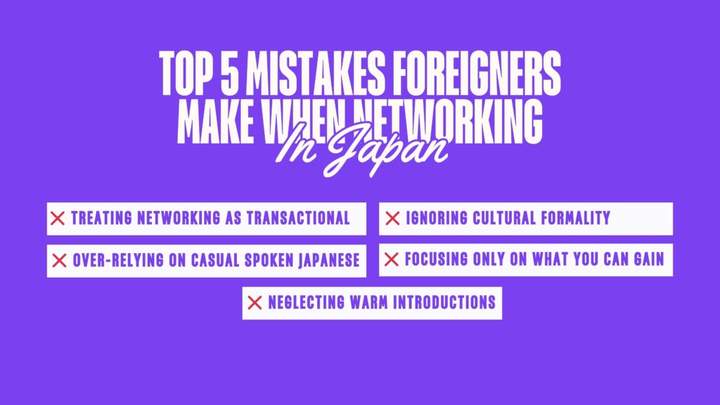
Mistake 1: Treating Networking as Transactional
The mistake: Approaching networking events with a clear, short-term agenda — “I want a job lead” or “I need introductions to X firm” — and signaling that agenda too quickly.
The fix: Shift your frame entirely. Go to every event with the goal of understanding the other person — their work, their challenges, their perspective — and offering something useful before the conversation ends. This reframe is not strategic manipulation; it is a genuine alignment with how meaningful professional relationships actually form in Japan.
Mistake 2: Over-Relying on Casual Spoken Japanese
The mistake: Presenting yourself as a Japanese speaker based on conversational ability, then struggling when professional communication demands reporting, formal correspondence, or technical vocabulary.
The fix: Be honest with yourself and others about your Japanese level. Pursue JLPT certification. Work specifically on written business Japanese, keigo usage, and the vocabulary of your professional field. Overrepresenting your Japanese ability damages trust much more than simply stating your level accurately.
Mistake 3: Neglecting Warm Introductions
The mistake: Defaulting to cold outreach — LinkedIn messages, direct event cold-approaches, unsolicited emails — because it feels efficient.
The fix: Map your existing network for second-degree connections to your target contacts or companies. Be specific when asking for introductions: “I’m hoping to connect with someone working in cross-border tax at X firm — do you happen to know anyone there?” makes the ask actionable. A single warm introduction is worth more than twenty cold messages in Japan’s professional culture.
Mistake 4: Ignoring Cultural Formality
The mistake: Applying casual, first-name-basis, Western networking norms to Japanese professional contexts — being overly familiar too quickly, skipping formalities, or treating hierarchical differences as irrelevant.
The fix: Mirror the formality level of your contact until they signal a shift. Use titles and family names until invited to do otherwise. Bow appropriately in in-person settings. Use polite language forms in written communication. These signals require very little effort but communicate cultural literacy that Japanese professionals actively value.
Mistake 5: Focusing Only on What You Can Gain
The mistake: Building a one-directional network — approaching every interaction with an underlying agenda of extraction, even if it’s not stated explicitly.
The fix: Actively look for opportunities to add value before receiving it. Share useful information, make introductions between your contacts, recommend resources, offer feedback. Over time, your reputation in the network becomes your most powerful networking tool — and in Japan, that reputation is built on what you give, not just what you have.
Top 10 Actionable Steps You Should Follow in Your First 12 Months of Networking for Japan?
This roadmap is designed for professionals networking toward Japan from abroad, but the steps translate directly for those already based in Japan.
Month 0–3: Audit, Refine, and Join
The foundation phase. Do not start mass-networking before you have your positioning clear.
- Audit your Japanese level honestly — consider formal testing if you haven’t already
- Draft your jikoshoukai in both English and Japanese (concise: name, affiliation, niche)
- Identify your specific value proposition for Japan — what is your cross-border niche?
- Join 3 targeted professional groups: one association, one niche forum in your field, one online community (LinkedIn group, Slack/Discord)
- Set up LinkedIn for Japan-specific outreach: add a Japanese-language summary, join relevant groups
Month 4–6: Attend, Engage, and Record
The visibility phase. Show up consistently and start building a contact record.
- Attend at least 2 events per month — mix virtual and local
- Bring business cards; have a proper card holder
- After each event, record every contact: name, company, what was discussed, follow-up sent
- Send personalized follow-ups within 48 hours of every meaningful conversation
- Identify 5–10 priority contacts – people whose professional sphere overlaps meaningfully with your goals
Month 7–9: Give, Deepen, and Request
The reciprocity phase. Start converting contacts into relationships.
- For each of your 5–10 priority contacts: offer something tangible – an article, a resource, a relevant introduction
- Request 2 warm introductions to people in your second-degree network
- Attend events where you’ve already seen familiar faces — being recognized builds credibility faster than any pitch
- Begin attending niche sector events rather than general networking mixers
Month 10–12: Convert and Evaluate
The outcome phase. Turn relationships into career-relevant conversations.
- Reach out to 1–2 specialist recruiters (Robert Walters, JAC Recruitment) for an informational conversation – not a job application, a professional market-reading conversation
- Request informational interviews with contacts at target firms or in target roles — frame them as learning conversations, not job inquiries
- Assess your language progress: are you ready for a formal assessment?
- Evaluate your portfolio of contacts: where are the gaps? Which relationships are genuinely warm? Where do you need more consistency?
- Decide on your next 12-month objectives based on what the first year has revealed
How Will You Measure Networking ROI in Japan — What KPIs Actually Matter?
Measuring networking outcomes in Japan requires a different framework than tracking open rates or response rates. The relevant metrics are relational, not volumetric.
Quantity vs. Quality: Tracking Introductions, Follow-Ups, and Conversion Rates
Trust Indicators: Repeat Meetings, Referrals, and Nemawashi Conversations
The most meaningful indicators of networking success in Japan are not quantitative. They are qualitative trust signals:
- Being invited to a second meeting by a contact without you initiating it
- Receiving a referral or introduction from a contact (they are vouching for you)
- Being included in informal pre-meeting discussions, this is nemawashi access and it signals genuine professional integration
- Being asked for your opinion or expertise by someone in your network
- Having a recruiter reach out to you rather than the reverse
Career Outcomes: Interviews, Offers, Projects, and Client Leads
Ultimately, networking ROI for career-focused professionals in Japan is measured in concrete outcomes. Track these annually:
- Number of informational interviews conducted
- Number of recruiter conversations initiated vs. received
- Job interviews sourced through network (vs. cold application)
- Project collaborations or client introductions traced to a networking contact
- Mentors or sponsors who have explicitly advocated for you
In Japan’s relationship-driven professional culture, the gap between these outcomes and zero is almost always explained by the same factor: how much trust you have invested in building, and how patiently you have sustained that investment over time.
Final Thoughts
Networking in Japan is not something you can sprint through. It is a long game — built on consistency, cultural fluency, genuine reciprocity, and the willingness to invest in relationships before they produce any visible return. For foreign professionals, particularly those in structured fields like accounting and finance, the technical credentials matter enormously. But the credentials are the entry ticket. What determines whether you actually get through the door is whether someone in Japan feels comfortable putting their name behind yours.
That comfort is built one conversation at a time, one follow-up at a time, one act of professional generosity at a time. The professionals who figure this out early — who stop trying to shortcut trust and start genuinely investing in it — are the ones who, twelve or twenty-four months in, find that Japan’s professional world has opened up in ways that can feel almost effortless. It never was effortless. It was just built properly from the start.
Related JoynTokyo reads

Ultimate Guide to Driving in Japan
A driver spent a week cruising Hokkaido and called it the most relaxing road trip of his life. Another took a mountain route from Kusatsu to Kanazawa and described it as “like being dialled into an F1 race car.” Both were experienced drivers. Both were in Japan. Both are right. Honestly, driving in Japan is

Cash vs Card in Japan: What Should You Use in 2026?
People who went to Japan five years ago will tell you cash is king. People who went last month will tell you they barely touched a note. Both are telling the truth, they just had different trips. The honest answer for 2026 is this: Japan has changed significantly. Most major establishments in cities now accept

Sheila Cliffe on The Kimono Closet and the Stories Kimono Hold
Sheila Cliffe is a longtime kimono researcher and the author of Kimono Style. In her new book, The Kimono Closet, she looks beyond kimono as fashion or art objects and instead explores their deeper place in family life, memory, and identity. She spoke with JoynTokyo to give us an exclusive look at the new book,