
Quitting Your Job in Japan: Everything You Need to Know Before You Resign
In early 2025, Tokyo police sent a hundred officers to raid the offices of Moody, Japan’s biggest job-quitting agency. Its founder, Tanimoto Shinji, was arrested. His crime? Helping people quit their jobs. That sounds absurd until you understand what quitting a job in Japan can actually look like. There are employers who have locked employees
In early 2025, Tokyo police sent a hundred officers to raid the offices of Moody, Japan’s biggest job-quitting agency. Its founder, Tanimoto Shinji, was arrested. His crime? Helping people quit their jobs.
That sounds absurd until you understand what quitting a job in Japan can actually look like. There are employers who have locked employees in rooms and demanded they sign documents admitting they owe millions of yen for resigning. Companies that file lawsuits purely to delay the inevitable. Bosses who treat a legal resignation as a personal betrayal. The situation is unusual enough that an entire industry, people you can hire to quit on your behalf, existed and flourished before regulators shut it down.
If you are a foreigner in Japan and you are thinking about leaving your current job, this guide gives you what you actually need: the legal rules, the practical steps, and an honest picture of what can go wrong and how to protect yourself.
What Should You Know Before Resigning in Japan?
Most people assume quitting a job is simple. Hand in notice, finish your last few weeks, and leave. In Japan, that sequence is broadly correct, but the details matter more than they do elsewhere, and the gap between what your company tells you and what the law actually says can be wide.
Open-Ended vs. Fixed-Term Contracts, Why the Difference Matters
How you can quit often comes down to the kind of agreement you signed. Not every contract works the same way when leaving.
If you are on an open-ended (無期) contract: the standard arrangement for most full-time employees, the Japanese Civil Code gives you the right to resign at any time. You give notice, and your employment ends two weeks later. That is the legal minimum. Some companies set longer periods internally, maybe four weeks or beyond, yet giving about one month shows common respect. Still, no policy can drop below the mandated fortnight. Should your agreement demand approval from a supervisor before leaving, do not worry – such terms hold no actual weight. Walking away needs no deal. It simply happens.
If you are on a fixed-term (有期) contract: one with a specific end date, the situation is stricter. In principle, you cannot terminate it mid-term without a valid reason. If you do, and the company suffers a demonstrable financial loss as a result, they may have grounds to claim damages. Fixed-term workers should always read the contract carefully and consider speaking with a labour consultant before resigning ahead of schedule.
One more scenario worth knowing: if your actual working conditions were materially different from what was described at the time of hiring, your hours, your role, your pay, the Labour Standards Act gives you the right to terminate immediately, regardless of contract type.
The Resignation Request vs. the Resignation Notice

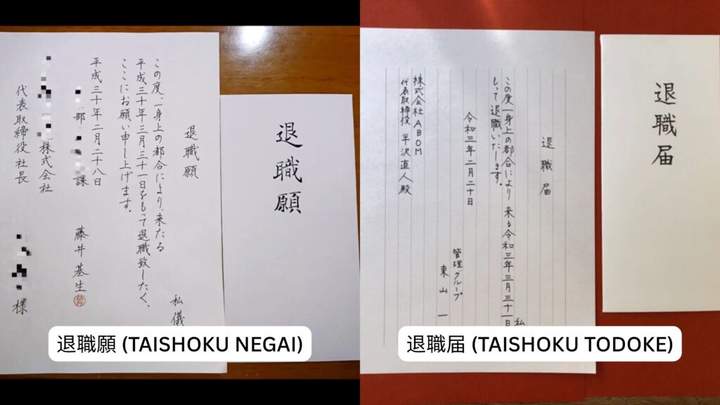
Two documents exist in Japanese resignation practice, and they carry different legal weight. The 退職願 (taishoku negai) is a request to resign – it implies you are asking for the company’s agreement. The 退職届 (taishoku todoke) is a formal notification of resignation – it does not require acceptance. For most people in most situations, a taishoku todoke is the right document to submit, because it removes the fiction that your employer has any power to refuse. The label matters less than the wording and intent, but using the right one from the start avoids unnecessary friction.
What Happens When a Company Refuses to Accept Your Resignation
No business has legal power to hold you against your will. With ongoing agreements, leaving after giving fourteen days’ notice stands even if your boss does not approve. People living abroad who face this situation often say one thing – present the decision like it’s already made, not something to haggle over. Last day on record – write it down, hold onto proof, yet see resistance as static, not a hurdle. As one commenter put it after their own experience: “This isn’t a negotiation. Your acceptance is not required. I am notifying you that I will no longer work here as of this date.”
Understanding your legal entitlements regarding work hours is no doubt important when dealing with Japanese labour law. For further insight into the mandates and restrictions placed upon employers, consult our guide to Japan’s working hours and labor standards.
How Do You Resign Properly in Japan?
The mechanics of resigning are fairly consistent across Japanese companies, and following them protects you, even if your employer is being difficult.
When and How to Tell Your Manager
The standard first step is a private conversation with your direct manager, not an email and not a group setting. Timing matters. Giving as much notice as is practically reasonable, ideally a month, at a minimum two weeks, reflects well on you and makes the handover smoother. If your relationship with your manager is the reason you are leaving, or if you are concerned about how they will react, tell HR directly or put your notice in writing first to establish a clear date on record.
Submitting Your Resignation in Writing
A conversation is not enough on its own. You should always submit your resignation in writing, even a short, formal note will suffice and keep a copy. Date the document clearly near the top. This creates an essential, documented record of when your notice was given, providing crucial proof if any later disputes arise regarding your final pay or official exit date. To establish a clear, unassailable timestamp, send the written notice by email in addition to handing it over in person.
Choosing Your Last Working Day
Your last working day should be stated clearly and specifically in your resignation letter, not “in approximately a month” but with an exact date. Count forward from the date you submit the letter. If you are on an open-ended contract and your company’s internal policy is one month, offering that is sensible. If the relationship has broken down and you want to exercise the two-week legal minimum, that is your right. Either way, commit to the date in writing and do not move it under pressure.
What Should You Say When Quitting Your Job in Japan?

The resignation conversation itself can feel intimidating, particularly in a culture where direct confrontation is generally avoided. The goal is to be firm and professional without being combative.
Useful Phrases for a Japanese Workplace
If you are resigning in Japanese, these phrases cover the essentials:
- 退職したいと思っております。 (Taishoku shitai to omotte orimasu.) — “I would like to resign.”
- 〇月〇日をもって退職させていただきたいと考えております。 (〇-gatsu 〇-nichi o motte taishoku sasete itadakitai to kangaete orimasu.) — “I would like my last day to be [date].”
- 大変お世話になりました。 (Taihen osewa ni narimashita.) — “Thank you sincerely for everything.” (Standard closing for a resignation conversation.)
Keep the explanation brief. Japanese resignation etiquette does not require a detailed breakdown of your reasons, and over-explaining can open the door to extended negotiation. A short, respectful statement of intent is enough. Understanding the intricacies of formal business language is very important for a Japanese workplace. Our guide to business Japanese: keigo and workplace phrases provides the necessary polite language and keigo for conversations and formal written notices.
How to Respond If Your Employer Tries to Delay Your Exit
Some managers will tell you they cannot accept your resignation. Others will say the timing is bad, that you owe it to the team to stay longer, or that your contract requires more notice than the law demands. These responses are common and, in most cases, not legally meaningful. The way to handle them is to stay calm, repeat your last working day clearly, and avoid being drawn into a discussion about whether your decision is reasonable. You do not need to justify it. If the pressure becomes serious, threats, withheld pay, harassment, document everything in writing and contact the Labour Standards Inspection Office (労働基準監督署) for guidance. They offer foreign-language consultation in some regions.
What Happens to Your Paid Leave and Final Paycheck?
This is where a lot of people get shortchanged, usually because they do not know what they are entitled to.
Using Remaining Paid Leave Before Your Last Day
You have the legal right to take your remaining annual leave before your resignation date. Your employer cannot deny this simply because it is inconvenient for them. The one caveat is the business reasons exception, but that exception does not extend past your final day. If they refuse to let you take leave, escalate to HR or a labour consultant. Many people in Japan schedule their notice period to overlap with their remaining holiday balance, effectively reducing the amount of time they actually work after resigning. This is entirely legal.
When Your Final Salary Should Be Paid
Under the Labour Standards Act, if you request it, any outstanding wages must be paid within seven days of your last day. Do not wait to ask; make the request in writing before your last day if possible, and confirm the payment date. Withholding final wages is illegal, full stop, though it does happen at some companies.
Bonuses, Overtime, and Other Unpaid Items
Any overtime hours worked must be paid. Any previously agreed bonus entitlements are usually governed by your contract terms. Check exactly what the conditions are for mid-year departures, as some companies prorate bonuses and others do not pay at all for partial periods. If you believe you are owed money that is not being paid, the Labour Standards Inspection Office can intervene.
What Documents Do You Need After Resigning?
Collecting the right paperwork before you leave or knowing exactly what to request makes everything that follows considerably easier.
Resignation Letter and Acceptance Records
Keep your own copy of the resignation letter you submitted, along with any email correspondence confirming it was received. If your company issues a formal acceptance, keep that too, though legally their acceptance is not required.
The Separation Notice (離職票)
The ririshokuhyo (離職票) is the key document you will need to claim unemployment benefits. Your employer is required to issue it. If they delay or refuse, contact Hello Work or the Labour Standards Inspection Office, both can compel issuance. Do not let a strained exit relationship result in you losing access to a document you are legally entitled to.
Retirement Certificate and Employment Record
If you need a formal record of your employment for future job applications, visa purposes, or reference checks, you can request a taishokushomeisho (退職証明書) from your employer. They are legally required to provide it without unreasonable delay, and they may only include information you specifically requested.
What Should You Do About Health Insurance and Pension?
The window for addressing these is short, and missing it creates real problems. You must act on both within two weeks of your last day, as timing matters more than many expect.
National Health Insurance After Leaving Your Job
Once your employer’s health coverage ends, you need to enrol in National Health Insurance (国民健康保険) at your local municipal office, generally within 14 days. The cost is based on your prior year’s income, which means premiums can feel steep if your previous salary was high. When you go, bring your certificate of resignation or separation notice to help the process move faster.
Voluntary Continuation of Employee Health Insurance
If you were covered through Kyokai Kenpo, you may be eligible to continue that coverage. However, the application deadline is strictly within 20 days of your resignation. If you miss that window, the option vanishes completely. For some, particularly those with dependents or anticipated medical needs, voluntary continuation can offer better coverage than switching to National Health Insurance.
National Pension After Leaving Your Job
If you stop being covered by employee pension (kosei nenkin) and are between 20 and 59, you must enrol in the National Pension (kokumin nenkin) at your municipality within 14 days of your last day. You will need proof of losing your employer-based coverage, such as your separation notice. Failing to register on time creates gaps in your contribution record that will reduce your eventual retirement payout.
The administrative transition of the health insurance system can be notoriously confusing, especially when resigning from a role. Our guide to what to do at city hall when you move or change jobs in Japan details the mandatory procedures for enrolling in National Health Insurance and the National Pension.
Can You Get Unemployment Benefits After Quitting?
Yes, but the conditions and timelines differ depending on how and why you left.
How Hello Work Handles Resignation Cases
Japan’s public employment service, Hello Work (ハローワーク), administers unemployment insurance. To start a claim, you register as a job seeker at your nearest office and submit your separation notice (離職票) along with your My Number documentation and ID. The process is relatively straightforward if you have all the documents.
Self-Quit vs. Company-Initiated Resignation
The distinction between voluntary resignation and dismissal affects how quickly benefits start. Workers who are dismissed or made redundant generally access benefits faster. If you quit voluntarily, the process still works, but there are waiting periods involved, and as of April 2025, the rules changed in a way that actually benefits most standard resigners.
Waiting Periods and the New 2025 Rules
There is a fixed seven-day waiting period that applies after your claim is decided, regardless of the reason you left work. Prior to April 2025, a voluntary resignation meant facing a waiting period of three months plus the initial seven days. Under the new 2025 rules, most voluntary resigners now only face an additional four-week delay beyond the initial week. The three-month restriction is still imposed in certain situations, such as if an individual quits voluntarily multiple times (e.g., twice in five years) or is dismissed for serious wrongdoing. Therefore, for most people who resign voluntarily, benefit payments typically begin around five to six weeks after their final day of employment.
What Happens to Your Visa If You Quit Your Job?
For foreign workers, this is where quitting gets more complicated than it is for Japanese nationals. Your employment situation and your residence status are linked in ways that have real legal consequences.
When You Must Report Your Job Change
For most work-related residence statuses, Engineer/Specialist in Humanities / International Services, Highly Skilled Professional, and similar categories, you are legally required to notify the Immigration Services Agency within 14 days of leaving your employer. This is not optional and it is not just paperwork. Failing to report can affect your next visa renewal. Your former employer also has their own 14-day reporting obligation in many categories. For a full breakdown of how visas work in the context of employment, see our work in Japan guide.
How Long You Can Stay in Japan After Resigning
Your current residence card remains valid until its expiration date even after you leave your job. Quitting does not invalidate your status immediately. However, your status is tied to the purpose it was granted for, if that purpose no longer exists, staying on the same status indefinitely is not something immigration will look favourably on. In practice, you have time to find a new role, but you should not treat your remaining visa validity as an indefinite safety net.
When to Contact Immigration If You Do Not Have a New Employer Yet
If you are between jobs and your next role is not yet confirmed, contact the Immigration Services Agency or speak with a certified immigration lawyer (行政書士 or 弁護士) as soon as possible. The options available to you, changing status, bridging periods, or applying for a designated activities visa, depend on your specific circumstances. Do not wait until your renewal is imminent to figure this out.
For foreign workers, managing your residence status is a critical part of the resignation process, as your legal standing and employment are linked in ways that carry significant weight. For a comprehensive overview of Japan’s work visa categories and their requirements, see our work visas in Japan guide.
What Should Foreign Workers Watch Out For?
Quitting a job in Japan involves the same process for everyone, but foreign workers carry additional risks that Japanese employees do not face.
Residence Status Tied to Your Employer
Some visas are effectively sponsorship arrangements where your right to stay is connected to a specific company. If you leave and do not secure a new role — or notify immigration — within a reasonable timeframe, you may find yourself in an irregular situation even if your card has not technically expired. This is particularly important for those on Intra-Company Transferee status, where the logic of the visa itself depends on your employment relationship with a specific company.
Side Jobs, Part-Time Work, and Permission Rules
If you are between jobs and considering part-time work to bridge the gap, check your residence status first. Many standard work visas do not automatically permit you to take on unrelated part-time employment. A Permission to Engage in Activity Other Than That Permitted (資格外活動許可) may be needed. Working without it is a status violation.
Finding a New Job Before Your Status Changes
The practical advice most expats share is simple: do not resign without a plan. That does not mean you need a new contract signed before you give notice– but having a clear timeline, an active job search, and a realistic sense of how long your visa validity gives you is essential. For guidance on the local job market, see our guide on how to get a job in Japan as a foreigner.
How Can You Quit Professionally Without Burning Bridges?
Japan is a country where industries are smaller and networks are tighter than they appear. The way you leave a job follows you more than it does in many other places.
Notice Period Etiquette in Japan
The cultural expectation around notice goes beyond the legal minimum. Giving a month — and using that time genuinely, not grudgingly- is noticed. It shapes how your colleagues and managers remember you, and in Japan, those memories have a long shelf life. This does not mean staying in a harmful situation longer than you should. It means that where a choice exists, erring toward generosity with your handover time pays off.
Handover Checklist Before Your Last Day
A thorough handover is one of the most valued things you can do on your way out of a Japanese workplace. It signals professionalism and respect for the people who remain. Before your last day, aim to: document ongoing projects and their current status, brief the person taking over your responsibilities directly, ensure no client or partner communication falls through the gap, and return all company property in good order. Keep records of what you returned and when.
Keeping Good Relationships for Future References
Reference culture in Japan operates differently from many Western countries — formal reference letters are less common, but quiet professional reputation is everything. The people you worked with may be asked about you, may be hiring managers at future companies, or may be the mutual connection that gets your CV read. Leaving without burning bridges is not just good manners. It is a practical career strategy.
What Are the Most Common Mistakes When Quitting a Job in Japan?
Most resignation problems are avoidable. The same issues come up again and again, and they are almost always the result of not knowing the rules in advance.
Quitting Without Written Notice
Telling your manager verbally and assuming that is sufficient is the first mistake. Without a written record of when you submitted your resignation, you have no protection if your employer later disputes your notice period, your final pay date, or your entitlements. Everything in writing. Everything kept.
Ignoring Pension and Insurance Procedures
The 14-day window for National Pension and health insurance registration is easy to miss when you are caught up in the stress of leaving a job. Missing it does not make the obligation disappear — it just creates gaps and administrative problems that take longer to fix than they would have taken to prevent. Set a reminder for the day after your last day.
Leaving Without Confirming Salary, Documents, and Visa Steps
The three things most likely to cause serious problems after you leave: outstanding wages that are not chased, separation documents that are never collected, and immigration notifications that are never filed. All three are easily handled when you are still in contact with your employer and your status is clear. All three become significantly harder to resolve once you have walked out the door and the relationship has cooled.
Frequently Asked Questions About Quitting Your Job in Japan
Can I quit immediately in Japan?
For open-ended contracts, the legal minimum notice period is two weeks — so a same-day walkout is technically a breach of the Civil Code, even if enforcement is rare. If your working conditions were misrepresented at hiring, or if you are experiencing serious harassment, the Labour Standards Act may allow immediate termination. When in doubt, speak with a labour consultant before acting.
Can my employer refuse my resignation?
No — not for open-ended contracts. A resignation is a notification, not a request for approval. If your employer says they are “not accepting” your resignation, that statement has no legal weight. State your last working day in writing and do not treat their reaction as a legal obstacle.
Can I use paid leave during my notice period?
Yes. This is one of the most useful things to know. You can schedule your remaining annual leave to run concurrently with your notice period, reducing the number of days you actually have to show up after resigning. Your employer cannot refuse this by simply pointing to business inconvenience during a period that ends on your last day anyway.
What happens if I do not return company property?
Your employer may withhold your final salary or pursue a civil claim if company property is not returned. Return everything — access cards, equipment, documents — on or before your last day, and get confirmation of the return in writing if possible. Do not give them a reason to complicate your exit.
What happens to my visa when I quit my job in Japan?
Your residence card stays valid until its expiration date. But you must notify the Immigration Services Agency within 14 days of leaving your job. If you do not have a new employer lined up, contact immigration or a lawyer promptly to understand your options. See our work in Japan guide for a full breakdown of how visa categories and employment interact.
Is it illegal to quit your job in Japan?
Not for open-ended contract workers who give proper notice. What can become a legal issue is quitting mid-term on a fixed-term contract without valid reason, or abandoning your role without any notice period. The practical risk from most resignations is civil rather than criminal — and even that is low for most people who follow the standard process.
What is a job-quitting agency, and can I use one?
Job-quitting agencies (退職代行) are services that contact your employer on your behalf to notify them of your resignation. They became popular because resigning in some Japanese workplaces is genuinely stressful and adversarial. However, the moment any conversation with your employer turns to contracts, severance, or legal terms, an agency that is not a registered law firm must disengage — they cannot provide legal counsel. The Moody case, where the founder was arrested in 2025, illustrated what happens when agencies cross that line. If you need a service like this, use one operated by a licensed labour law firm rather than a general agency.
Do I need to give a reason for quitting?
No. You are not legally required to explain why you are leaving, and in most professional situations, keeping the reason brief and neutral is better than going into detail. “I have decided to pursue a new direction” is enough. You do not owe your employer a full explanation.
Final Thoughts
Quitting a job in Japan is not as simple as it is in some countries, but it is far more manageable than the horror stories suggest — as long as you know the rules before you start. Give proper notice in writing, use your remaining leave, collect your documents, handle your pension and insurance within the two-week window, and check your visa situation before anything else. That covers most of what can go wrong.
If you are a foreigner and your next step is finding a new role, our Japanese job interview guide and how to get a job in Japan are good places to continue from here.
Related JoynTokyo reads

Ultimate Guide to Driving in Japan
A driver spent a week cruising Hokkaido and called it the most relaxing road trip of his life. Another took a mountain route from Kusatsu to Kanazawa and described it as “like being dialled into an F1 race car.” Both were experienced drivers. Both were in Japan. Both are right. Honestly, driving in Japan is
Cash vs Card in Japan: What Should You Use in 2026?
People who went to Japan five years ago will tell you cash is king. People who went last month will tell you they barely touched a note. Both are telling the truth, they just had different trips. The honest answer for 2026 is this: Japan has changed significantly. Most major establishments in cities now accept

Sheila Cliffe on The Kimono Closet and the Stories Kimono Hold
Sheila Cliffe is a longtime kimono researcher and the author of Kimono Style. In her new book, The Kimono Closet, she looks beyond kimono as fashion or art objects and instead explores their deeper place in family life, memory, and identity. She spoke with JoynTokyo to give us an exclusive look at the new book,