
Best Apps for Learning Japanese: Fast, Affordable, and JLPT-Ready Picks
Learning and language is easier when you have the right tools, and Japanese is no exception. As someone who’s studied and lived in Japan for several years, I’ve had the opportunity to test and compare the most popular Japanese learning apps, and I’ll detail my experiences to you now, based on real-life usefulness, user experience,

Learning and language is easier when you have the right tools, and Japanese is no exception. As someone who’s studied and lived in Japan for several years, I’ve had the opportunity to test and compare the most popular Japanese learning apps, and I’ll detail my experiences to you now, based on real-life usefulness, user experience, and JLPT-level support.
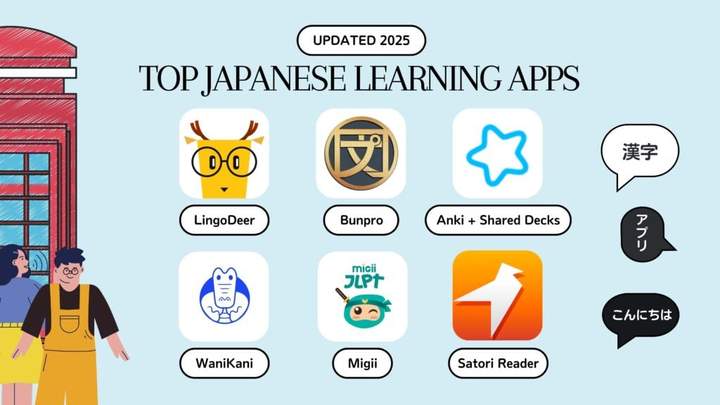
Apps To Choose by Use Case
Top Apps To Learn Japanese – Comparison Table
LingoDeer
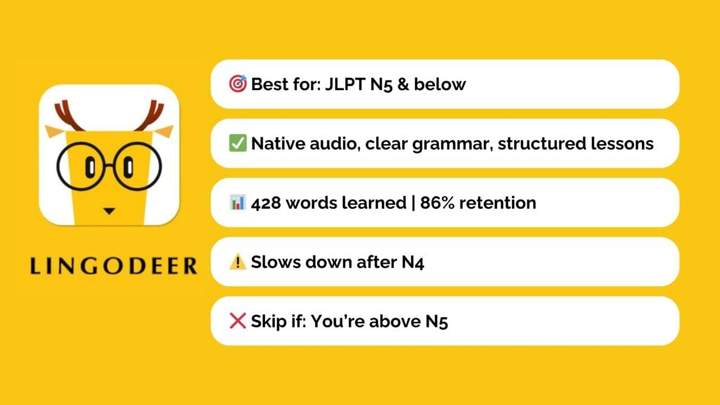
- Verdict: In my view, this app is still the best guided start to learning Japanese
- Pros: It has native audio, detailed grammar notes, and structured learning levels
- Cons: Learning progression slows after N4
- Data:
Average words learned: 6 to 7 per lesson - Retention: 86% (7-day average)
Best for: Beginners
Skip if: You’ve already passed JLPT N5
Bunpro
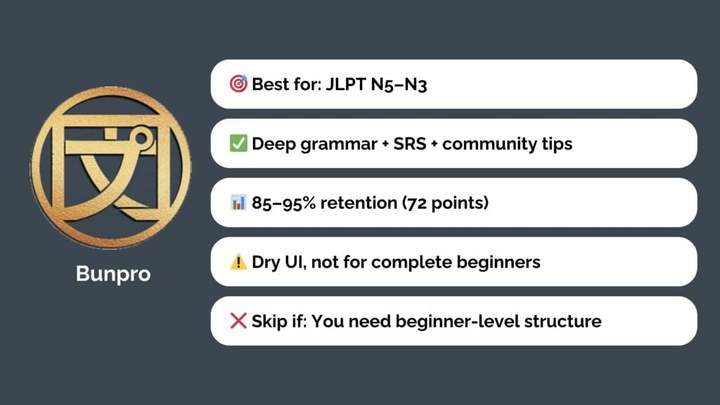
- Verdict: Grammar-focused spaced recognition system learning (SRS) built for JLPT test-takers
- Pros: Gives detailed sentence breakdowns, and the community notes help clarify issues
- Cons: Some UI friction and a dry, un-engaging interface
- Data:
N5 to N3 grammar points reviewed: 72 - Retention: 85% to 95% (user reported)
Best for: JLPT-focused learners
Skip if: You need beginner-level structure
WaniKani
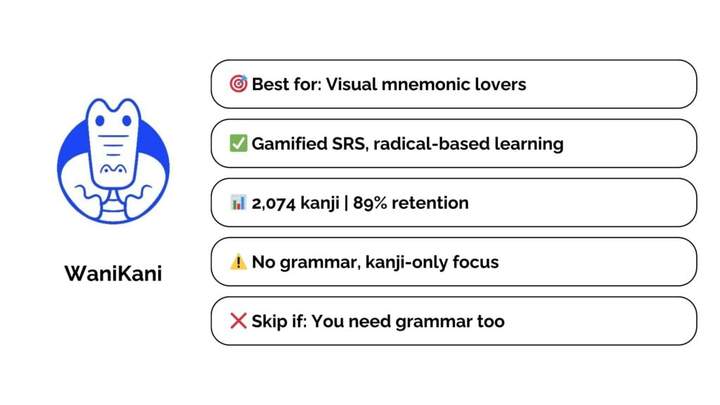
- Verdict: Fun but intense kanji memorization tool
- Pros: Radical-based learning and gamified SRS, to hold the learner’s attention
- Cons: Limited outside kanji, no grammar
- Data:
Kanji on offer: 2074 - Average retention rate: 89% (user reported)
Best for: Visual mnemonics learners
Skip if: You want grammar in one place
Migii
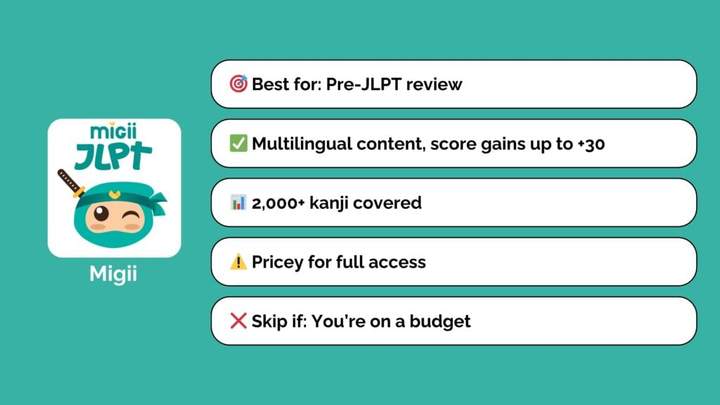
- Verdict: Excellent for brushing up before the JLPT
- Pros: Extensive materials in various languages
- Cons: Relatively expensive for full suite of materials
- Data:
Kanji learned: 2000+ - Improvements: JLPT scores boosted by up to 30 points
Skip if: You’re seeking an app friendlier on your wallet

Long Hoang
Migii User & JLPT N2 Holder
This app is recommended for anyone looking to get a boost before the JLPT exam, as it contains previous year exams.
Anki
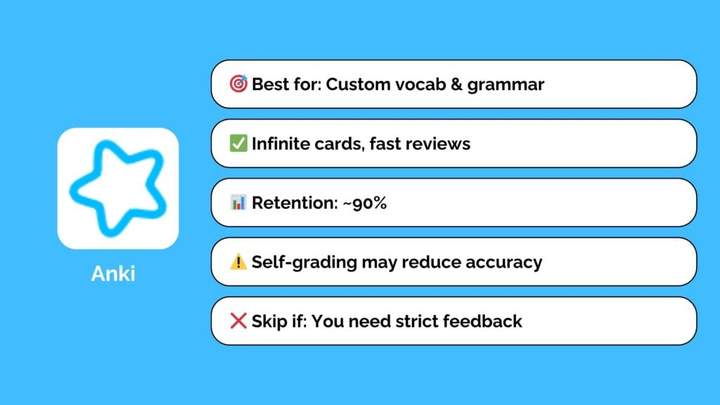
- Verdict: Highly customizable for specific learning outcomes
- Pros: Customizable flashcards, as well as a surprisingly fast reviews of content
- Cons: Self-grading in reviews makes it easier to cheat yourself
- Data:
Flash cards available: Hypothetically infinite - Retention: Roughly 90% (user reported)
Best for: Those looking to learn specific vocabulary or grammar
Skip if: You require the discipline of an external grader
Satori Reader
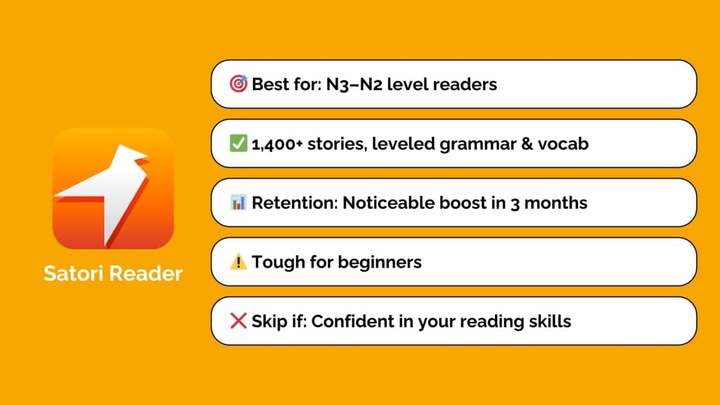
- Verdict: The premier app when it comes to improving reading comprehension
- Pros: Extensive list of reading material to improve grammar and vocabulary, grouped by difficulty
- Cons: Not as accessible for those with a sub-N3 knowledge of Japanese
- Data:
Reading “episodes” available: 1,400 - Retention: Big improvement in just 3 months (user reported)
Best for: Intermediate readers looking to improve
Skip if: You are confident in your reading skills
Can I reach fluency using just apps?
Yes and no. While you will be able to learn the vocabulary, grammar, and kanji through app learning, to the point that you may be able to read and write efficiently, there is no substitute for actually speaking to Japanese people. Of course, you cannot progress in conversations or immersive learning without some background, so apps will still be essential for most people who want to become fluent.
Many language apps guide learners through structured lessons that focus on vocabulary, grammar, and kanji recognition, which can help build a solid foundation over time. However, these tools often provide limited opportunities to practice real conversations with other people. Because of this, some learners also turn to one-on-one tutoring through online learning platforms like italki and others, where they can choose tutors and schedule lessons that allow them to practice speaking, improve pronunciation, and apply what they have learned in a more interactive setting.
Notable Mention
Which app is best for learning kanji?
What’s the best free Japanese learning app?
Anki, which is a free app, is especially good for customized flashcards, and so customized learning. This means that no matter what your level, you will be able to tailor your study to your own needs.
Can I pass JLPT N5 without classes?
It is possible to pass the JLPT N5 without classes: I did so myself. However, N5, as the simplest and easiest test, still requires hours of learning, even if that is incidental, by talking to friends or reading manga. I would recommend that you do some study for it anyway: it will be good practice for N4 and above, when study will be essential.
Recommended Textbooks To Learn Japanese

Apps are not the only way to learn Japanese, of course. People have been learning with books for centuries, and there are a number that you can rely on when your phone is low on battery.
Related JoynTokyo reads

Ultimate Guide to Driving in Japan
A driver spent a week cruising Hokkaido and called it the most relaxing road trip of his life. Another took a mountain route from Kusatsu to Kanazawa and described it as “like being dialled into an F1 race car.” Both were experienced drivers. Both were in Japan. Both are right. Honestly, driving in Japan is

Cash vs Card in Japan: What Should You Use in 2026?
People who went to Japan five years ago will tell you cash is king. People who went last month will tell you they barely touched a note. Both are telling the truth, they just had different trips. The honest answer for 2026 is this: Japan has changed significantly. Most major establishments in cities now accept

Sheila Cliffe on The Kimono Closet and the Stories Kimono Hold
Sheila Cliffe is a longtime kimono researcher and the author of Kimono Style. In her new book, The Kimono Closet, she looks beyond kimono as fashion or art objects and instead explores their deeper place in family life, memory, and identity. She spoke with JoynTokyo to give us an exclusive look at the new book,