




Your JLPT certification directly determines which careers you can pursue in Japan. N5 holders can access hospitality and manual labor roles, while N1 certification opens doors to high-paying corporate positions, translation work, and specialized professions. This guide matches each JLPT level (N5 through N1) to realistic career options, visa requirements, and expected salaries.
JLPT N5: Entry-Level Service and Labor Positions
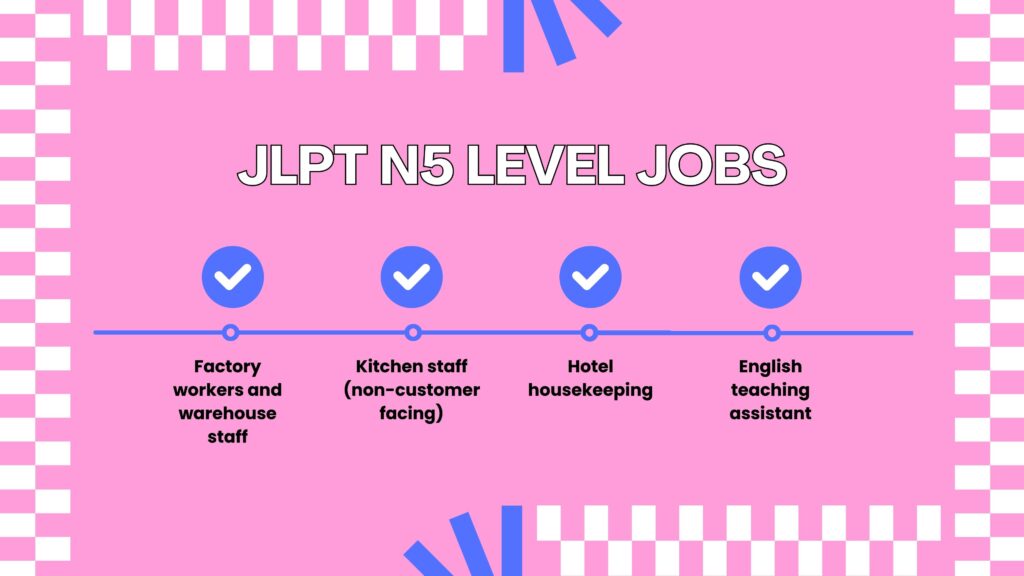
Realistic Career Options
At N5 level, your Japanese is limited to basic phrases and simple conversations. Career options focus on roles with minimal customer interaction or multilingual support:
- Factory workers and warehouse staff: Manufacturing companies often hire foreign workers with basic Japanese for production lines
- Kitchen staff (non-customer facing): Dishwashers, prep cooks in restaurants that serve international customers
- Hotel housekeeping: Cleaning roles with basic instruction comprehension needed
- English teaching assistant: Support roles at English conversation schools (eikaiwa) where Japanese proficiency isn’t the primary requirement
Salary range: ¥180,000-¥250,000/month
Visa pathway: Specified Skilled Worker visa (特定技能) for manufacturing/hospitality, or dependent visa if applicable
JLPT N4: Customer Service and Service Industry Roles
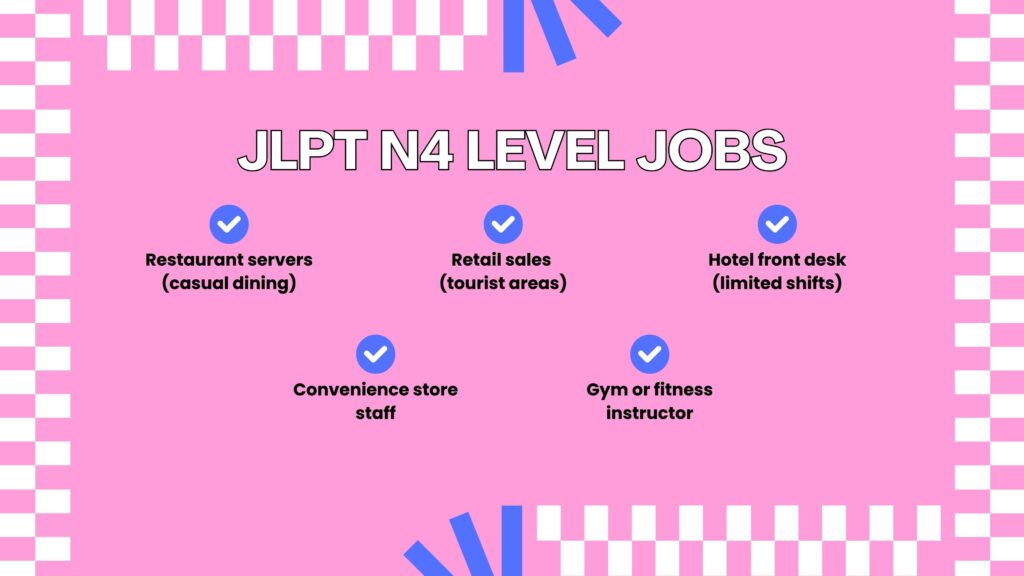
Realistic Career Options
N4 proficiency allows you to handle everyday conversations and simple workplace communication. This opens service-oriented positions:
- Restaurant servers (casual dining): Taking orders, basic customer service at restaurants with picture menus or international clientele
- Retail sales (tourist areas): Working in shops frequented by tourists where product knowledge matters more than complex Japanese
- Hotel front desk (limited shifts): Assisting with check-in/check-out during tourist seasons
- Convenience store staff: Operating registers, stocking shelves with basic customer interaction
- Gym or fitness instructor: Leading classes where demonstration is primary, Japanese is supplementary
Salary range: ¥200,000-¥280,000/month
Visa pathway: Specified Skilled Worker visa, Working Holiday visa, or spouse visa
Boost Your Chances of Finding the Right Opportunity!
Speak to our consultants to find out how you can start working in Japan!
Book Your FREE Consultation✓ 500+ Bookings as of 2026-07-31 ✓ English-speaking support
JLPT N3: Administrative Support and Specialized Service Roles
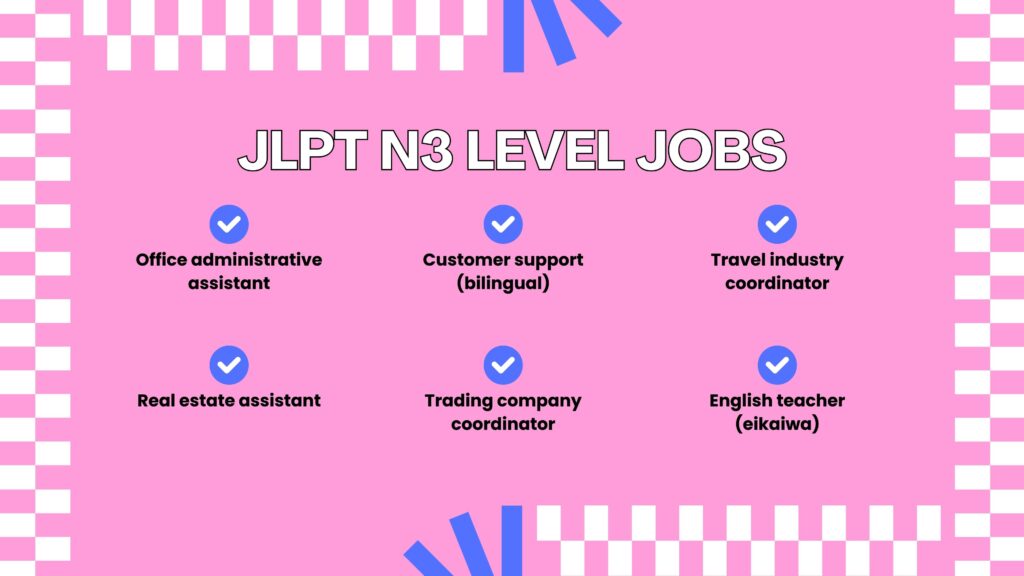
Realistic Career Options
N3 represents intermediate proficiency where you can understand most everyday conversations and handle workplace discussions. Career options expand significantly:
- Office administrative assistant: Data entry, filing, basic correspondence in companies with international divisions
- Customer support (bilingual): Handling inquiries for foreign customers in Japanese and your native language
- Travel industry coordinator: Assisting with tour bookings, itinerary planning for international tourists
- Real estate assistant: Supporting foreign clients looking for apartments in Japan
- Trading company coordinator: Basic import/export documentation and communication support
- English teacher (eikaiwa): Full teaching positions at conversation schools with Japanese staff support
Salary range: ¥230,000-¥320,000/month
Visa pathway: Specialist in Humanities/International Services visa, Instructor visa for teaching roles
JLPT N2: Professional Corporate Positions
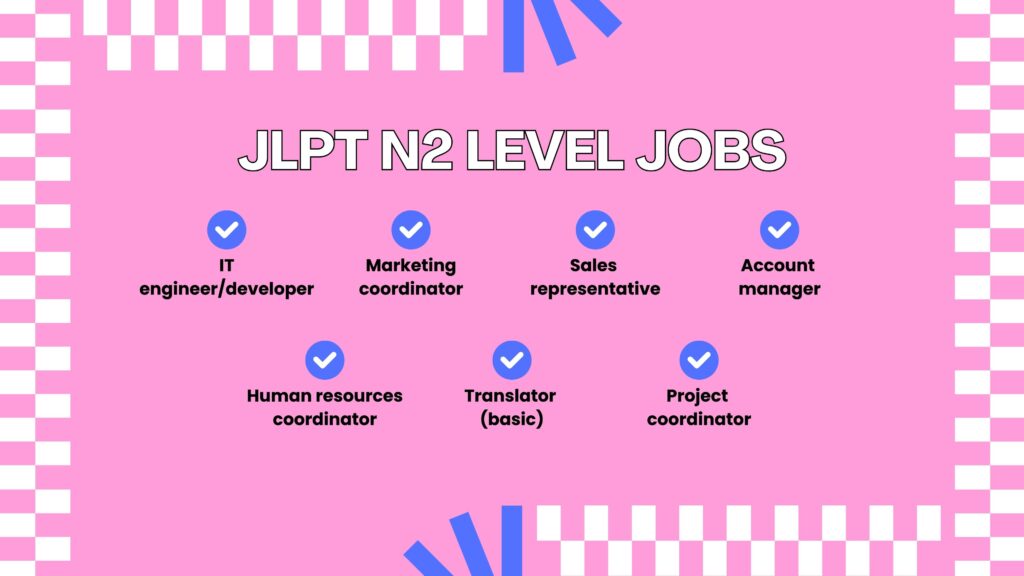
Realistic Career Options
N2 is the gateway certification for serious professional work in Japan. You can read newspapers, understand business discussions, and produce workplace documents. This is the minimum level most Japanese companies require for foreign hires:
- IT engineer/developer: Software development, system engineering at Japanese tech companies
- Marketing coordinator: Managing international marketing campaigns, social media, and content creation
- Sales representative: B2B sales positions, especially in companies targeting overseas markets
- Account manager: Client relationship management for international business
- Human resources coordinator: Recruitment, onboarding, and employee support in global companies
- Translator (basic): Translating business documents, emails, and marketing materials
- Project coordinator: Supporting project management in manufacturing, consulting, or tech sectors
Salary range: ¥280,000-¥450,000/month
Visa pathway: Engineer/Specialist in Humanities/International Services visa, Highly Skilled Professional visa (if points qualify)
Read More
JLPT N1: Executive, Specialized, and High-Level Professional Roles
Realistic Career Options
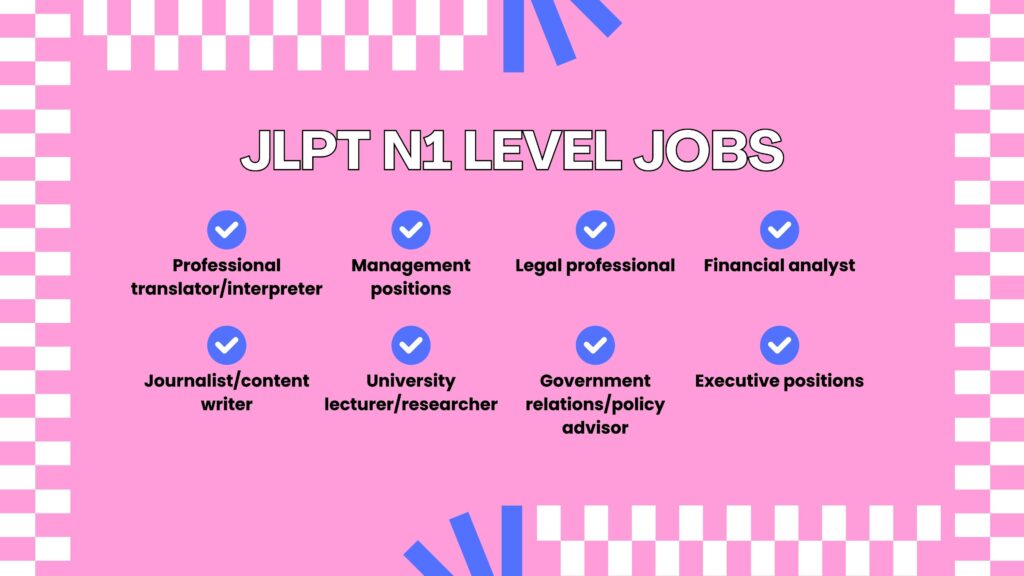
N1 certification demonstrates near-native proficiency with the ability to understand complex texts, business nuance, and cultural context. This unlocks the full spectrum of professional careers in Japan:
- Professional translator/interpreter: High-stakes business negotiations, legal interpretation, medical translation
- Management positions: Department managers, project managers, and team leads in Japanese corporations
- Legal professional: Paralegal work, legal consulting (full lawyer status requires Japanese bar exam)
- Financial analyst: Investment banking, financial consulting, corporate finance roles
- Journalist/content writer: Writing for Japanese publications, news organizations, or corporate communications
- University lecturer/researcher: Teaching at Japanese universities or conducting research
- Government relations/policy advisor: Working with governmental organizations or as a policy consultant
- Executive positions: C-level roles in multinational companies operating in Japan
Salary range: ¥400,000-¥800,000+/month
Visa pathway: Highly Skilled Professional visa, Professor visa (academic roles), or standard work visas with preferential processing
Read More
Strategic Career Planning by JLPT Level
If You’re Currently at N5 or N4
Accept that your initial role in Japan will likely be service-oriented or labor-based. Use this period to improve your Japanese while gaining work experience. Many successful professionals in Japan started in hospitality or teaching roles while studying toward N3 or N2.
If You’re at N3
You’re in the transitional zone. Focus on passing N2 within 1-2 years to access professional corporate positions. Meanwhile, target companies with international divisions where your bilingual skills add immediate value.
If You’re at N2 or N1
You have genuine career mobility in Japan. Research specific industries aligned with your background, as your Japanese proficiency is no longer the limiting factor. Your technical skills, experience, and cultural fit become the differentiators.
Read More

Key Factors Beyond JLPT Level
While JLPT certification determines eligibility, these factors significantly impact your actual career prospects:
- University degree: Required for most work visas in professional roles regardless of JLPT level
- Relevant work experience: 3+ years in your field can offset lower Japanese proficiency in technical roles
- Industry demand: IT, engineering, and healthcare have labor shortages and may be more flexible with language requirements
- Company size and culture: Multinational corporations often require lower Japanese proficiency than traditional Japanese companies
- Location: Tokyo and Osaka offer more opportunities for lower JLPT levels due to international business concentration
Frequently Asked Questions
Can I work in Japan without any JLPT certification?
Yes, but options are extremely limited. Some English teaching positions and highly specialized technical roles (especially in IT) hire based on English proficiency alone. However, having at least N4 significantly expands your opportunities and quality of life in Japan.
Do all Japanese companies require JLPT certification?
No. JLPT certification is proof of proficiency, but many companies conduct their own language assessments. Some multinational companies in Japan don’t require JLPT at all, preferring to evaluate Japanese ability through interviews. However, having certification makes job hunting much easier.
What’s the minimum JLPT level for a comfortable life in Japan?
N3 is generally considered the minimum for independently handling daily life, understanding important documents, and having meaningful relationships. N2 allows you to participate fully in workplace culture and community life.
Should I wait to pass N2 before job hunting in Japan?
Not necessarily. If you’re currently at N3 and have valuable technical skills, start applying. Many companies hire N3 holders who are actively studying for N2. However, if you’re at N5 or N4 with no specialized skills, improving to N3 first may be strategic unless you’re pursuing teaching or hospitality.
Action Steps by Current JLPT Level
N5/N4: Enroll in intensive Japanese courses, target service industry roles to immerse yourself in Japanese, set a 6-month goal to pass the next level
N3: Start applying to bilingual positions while studying for N2, join industry networking groups, consider internships or contract work to gain Japanese workplace experience
N2/N1: Apply broadly to positions matching your expertise, emphasize your business Japanese skills, consider specialized industries where your unique background adds value beyond language alone
Read More